
When The Nightmares Come
A peek into a mother's memoir of war, estrangement, and the dream she can't escape.

I’m sitting at my desk brainstorming chapter seven of my novel when I see them through the window.
Two men. Army dress blues so deep they look almost black in the morning light, single-breasted jackets pressed to a knife’s edge, brass buttons catching the sun like small fires. White shirts buttoned to the throat. Their service caps perfectly level, worn with the kind of precision that doesn’t allow for a single degree of error.
They move up my driveway with measured, deliberate steps. The walk of men trained to hold their bearing through anything meant to break the soul. Men who understand that the uniform itself is part of the message — that its sharpness is not vanity, but respect. That the United States Army sends its best-dressed soldiers to tell you your son is gone.
I am shaking before I reach the door. Not the polite trembling of someone who is cold. Full-body shaking, the kind that starts somewhere in your chest and radiates outward until your hands are useless. A faint ringing unfurls inside my ears. My bare feet find every cold ridge of the hardwood floor, each step its own small shock.
I rip my glasses off my face. They feel suddenly unbearable — too heavy, too much against my skin — and I don’t know where they land.
The sweatshirt I’m wearing feels like it’s tightening around me. Like the fabric has decided this is the moment to become a trap. I can’t get enough air. Everything is too close.
Outside, cardinals are singing. Just cardinals, doing what cardinals do on an ordinary morning, singing into a world that is ending. The sound is obscene in its normalcy. The whole morning feels aloof, untethered — like it hasn’t gotten the news yet.
I open the door.
My mouth is so dry I couldn’t speak even if I knew what to say. The air has been sucked out of me. My stomach ties itself in knots.
One of them looks at me with practiced softness.
“Ma’am, on behalf of the United States Army, we regret to inform you that your son—”
I don’t hear the rest.
My knees find the floor before my mind understands why. The sound that tears out of me isn’t mine — it belongs to something older, something primal, something that has been making this sound since the first mother lost the first son. It fills the room and then it stops.
Silence shaped like a scream.
My hands are splayed on the hardwood and I stare at them like they are evidence of something. The lines in my knuckles. A hangnail I meant to fix. The same hands that counted his fingers the night he was born — ten perfect reasons to believe the world was good. His little face flashes before me. My baby. And then it’s gone.
Someone is talking. There are shoes near the door. A hand on my back that I feel from very far away, the way you feel rain through a window.
My lungs are working. I know this because I am still here, which seems impossible, which seems like a mistake someone made.
The tightness in my chest is not pain exactly. It is pressure — the feeling of something that has been held together a very long time finally deciding not to be. I press my fist against my sternum like I can hold it. Like that will do anything.
My husband’s hands find me. I don’t know how much time has passed. He doesn’t speak — there is nothing to say and he knows it — he just gets low and pulls me against him, and for a moment I let myself be a body someone else is carrying. He walks me toward the stairs and I go, because my feet will follow him even when the rest of me has stopped working. That much is muscle memory. That much, my body still knows.
I make it to the third step.
Then I am down again. Not falling — dissolving. My back against the banister, my knees pulled up, and the tears don’t feel like tears. They feel hot and constant, like something is draining out that was never meant to leave.
The cardinals keep singing outside.
Like we aren’t at war.
Like everything is fine.
Like I didn’t just lose my son.
I have this dream often.
Usually the scream wakes me — leaves me gasping in the dark, heart hammering, relief flooding in slowly as I remember where I am. This time it didn’t. This time I stayed. I grieved. I attended his funeral. I held his flag-draped casket one last time while honor guards presented me a perfectly folded American flag. Thirteen folds, each one standing for something — life, eternal life, honor for the veteran, for the nation, for mothers and fathers and the armed forces — and on the final fold, stars and the motto: In God We Trust.
In that dream, I felt no God. Only pain. Only the heavy weight of a grief that hasn’t happened yet but already lives inside my body like it has.
I woke sobbing into my pillow at 3 AM, cheeks wet, hollowed out with the exhaustion of having already survived something that isn’t over. My husband slept on, his breathing steady and even. I slipped out from beside him and took myself to the bathroom to fall apart in private.
My son is twenty-three years old and stationed at Fort Liberty, North Carolina, assigned to the 18th Airborne Corps. He is somewhere I cannot reach him.
That is not a new feeling.
He has been somewhere I cannot reach him for most of his life — not always because of geography, and not always because of war. He grew up inside my survival story, watching his Dad and ex-stepdad destroy me and absorbing the consequences of choices I made before he was old enough to understand them. Those same men put him through hell too. And while I was to stuck to surviving, I didn’t see his pain. I didn’t protect him, not because I didn’t want to, because I couldn’t, until it was too late. And in return, my survival forced him to write his own. I just don’t get to read it.
I left when he was thirteen and still needed me. I won’t dress it up or sand the edges off it. I had reasons. Good ones. Survival-level reasons. The kind that, when you explain them to a therapist, make her nod and say of course you left, you had no choice — and you believe her in the room, and then you go home and lie awake anyway, because reasons are not the same as absolution. A child doesn’t care about your reasons when you’re gone. I never wanted to leave him. That wasn’t supposed to be how our story went. But it happened. It’s easy to focus on the choice that was made. I’ve learned that people rarely choose to look at the options one has - only the choice made. And I made a choice that broke my child in ways he may never recover from.
I can hold two things to be true at the same time.
He didn’t see the parental alienation. He didn’t see the post-separation abuse, the smear campaign, the years of calculated destruction. He just saw that his mom left him.
I left him with his MAGA father. His father, who filled the silence I made with Fox News, manosphere podcasts, grievance, and the intoxicating myth of masculine self-sufficiency. A man who hated me. Who handed him a worldview the way some fathers hand their sons a rifle — as inheritance, as identity, as the thing that will make you a man. I don’t know exactly when MAGA became the water my son swam in. I only know that by the time I found my way back to him, it was already in his lungs.
We reconnected when he was nineteen. His father had threatened to send him to a homeless shelter — our son, nineteen years old, with nowhere to go — and after years of me begging for the chance to have him back, his father finally relented. As if our son were something to be granted or withheld. As if he ever stopped being mine.
He moved in and we spent months carefully, tenderly learning each other again. Who he had become. Who I had become. Two people who loved each other and were also essentially strangers, navigating the wreckage of a childhood neither of us had wanted for him. It was awkward and sweet and fragile the way repaired things always are — you could feel the seams.
During that time, he decided he wanted to join the Army. I supported it because he was happy and certain in a way I hadn’t seen before, and ultimately it wasn’t my choice to make. We were also in peacetime when he joined — we had just pulled out of Afghanistan — and that gave me something to hold onto. He never graduated from high school, so he didn’t feel like he had too many options left. This would give him work experience and discipline and help with his GED and money for college. He saw his path.
I went to his boot camp graduation and stood watching him in formation and felt something crack open in my chest. Pride, yes. But also the particular grief of a mother watching her son march toward something she cannot follow him into. He had become a man. I could see it in his eyes — the discipline, the steadiness, the confidence. He spoke with kindness and respect.
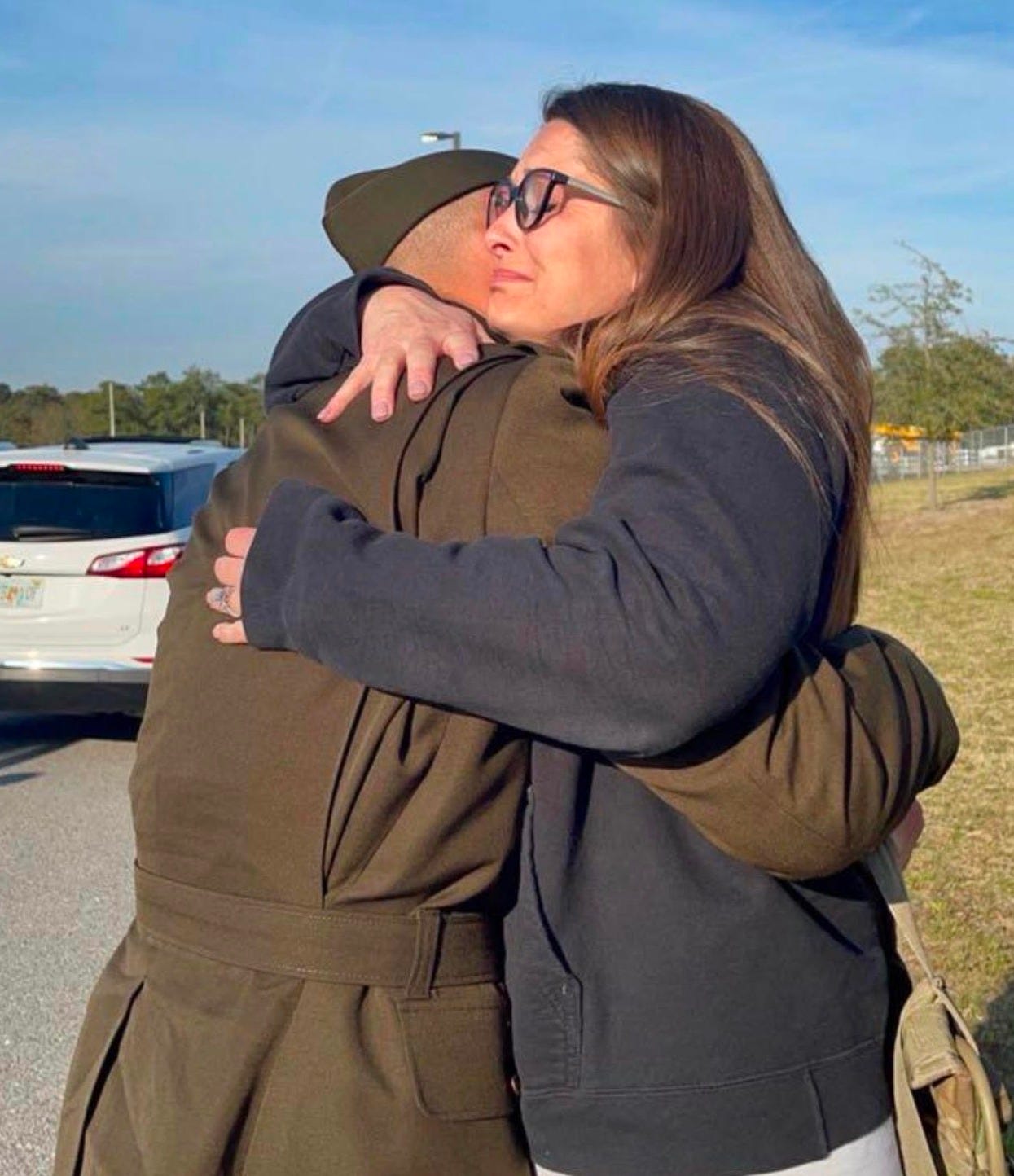
He shipped to South Korea soon after AIT. Kuwait after that. And something shifted.
He reconnected with his father. Found the manosphere again. And I became the enemy — the mother who left, the obnoxious leftist bitch, the woman who didn’t know her place in the story his father had been telling about her for years. I watched it happen in slow motion. When Trump was elected, whatever thread was still holding us snapped. We had a blowout fight — him pro-MAGA, me everything-but — and afterward the silence came back, heavier than before. It wore the shape of politics but it was built out of something much older and much harder to say.
I understood. I hated it. I kept reaching for him anyway.
Estrangement from your child who is also a soldier, in an active war you do not support, means every unexpected knock at the door is a rehearsal for the dream. It means watching the news has become a form of self-harm you can’t stop doing.
Trump is floating the idea of sending in ground troops.
Ground troops. The words land in my chest like a fist every time. I do the math on his unit, his role, his proximity to wherever it’s happening. I search for public announcements. I read Wikipedia pages about the 18th Airborne Corps at 11 PM and feel insane and also completely rational.
I can’t get his two-year-old face out from behind my eyelids.
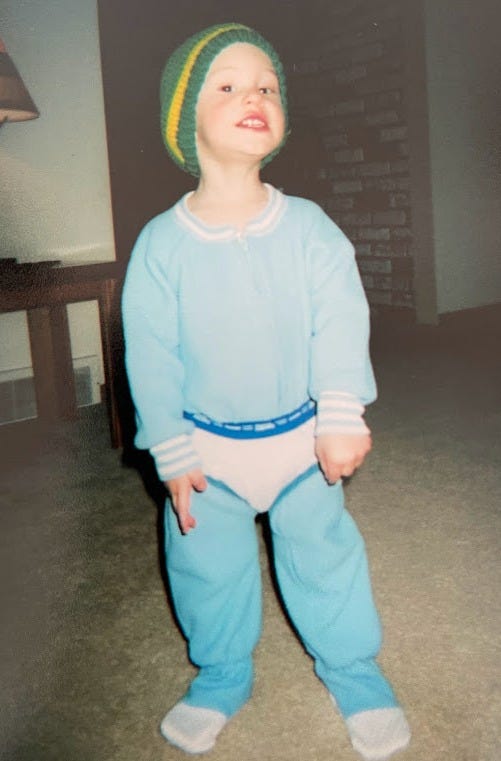
Round cheeks. That goofy, silly-goose energy he carried everywhere, like the world was a joke only he was in on. He loved Bob the Builder with the intensity only toddlers can summon for things that don’t matter at all and somehow matter completely. I’d hear his tiny voice from another room: Can we fix it? Yes. We. Can! And that laugh — God, that laugh. It would stop me mid-sentence, mid-thought, mid-whatever, because it was the kind of laugh that demanded everything. It was so jolly. I’d start laughing too, not even knowing what was funny, just caught in the pure animal joy of it.
I remember the weight of him when he fell asleep in my arms. The way small children go completely boneless when sleep takes them — mouth open, that particular heaviness that is somehow both nothing and everything. I’d carry him to bed and tuck the blanket around him and press my lips to his forehead so gently I was barely there. And in the morning he’d come padding into my room and crawl in beside me and just — settle. His small warm body tucked against mine. Both of us still half asleep. The world not yet started.
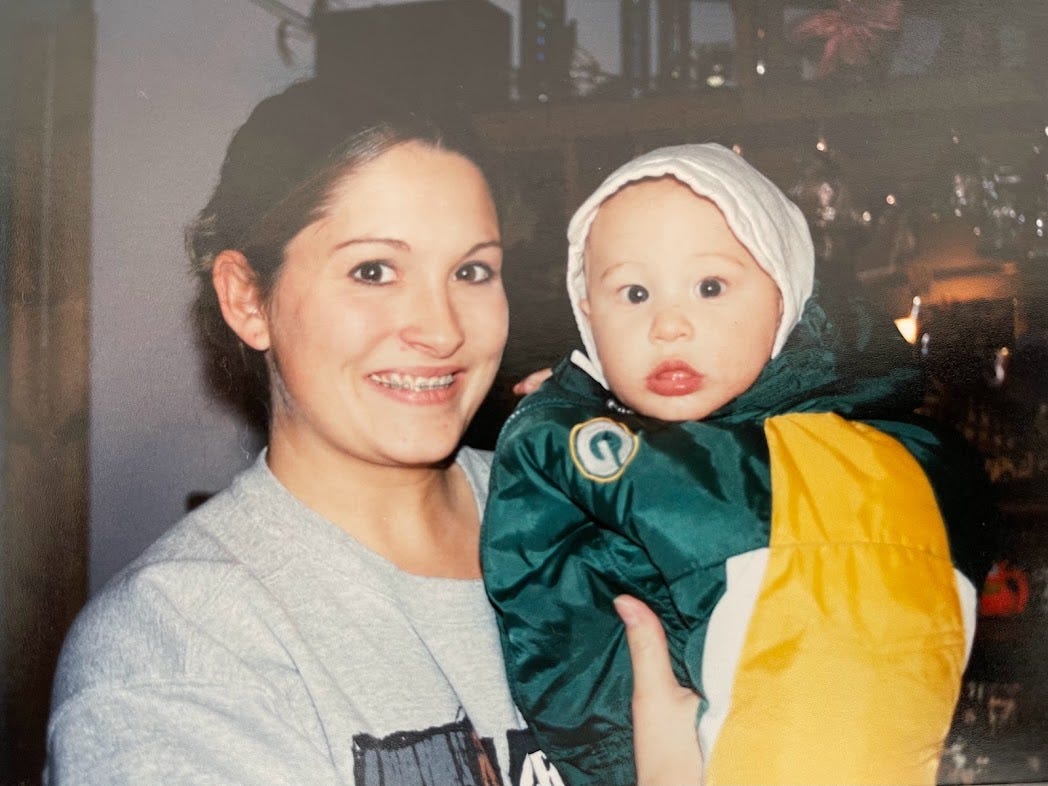
He called me Mama.
Now he calls me Ma. On the days he calls me anything at all.
It feels like I have been writing him letters for years with nowhere to send them. Pages and pages addressed to a man I helped make and then failed to fully raise — full of apologies that don’t shrink the distance, explanations that don’t change what I did, and love that has nowhere to land.
I send him a few texts a week. He answers occasionally, and only the neutral ones. Talking feelings is off the table. I have been completely cut out of his day to day life. I understand this. I make sure he knows I’m thinking of him anyway. That I love him. But, now, he doesn’t answer at all. I don’t know what that means. Is he angry again? Getting ready to deploy? Or is he finally done with me for good?
I’ve done the research the way mothers do. Soldiers under the 18th Airborne Corps lock down their social media before deployment. Go dark. OPSEC — operational security. They vanish from the internet so the enemy can’t track unit movements, and the casualty of that protocol is every person who loves them, left sitting with the silence and their worst dreams. I don’t know if that’s what this is. I hope not.
I sent an email tonight to the unit’s rear detachment. I have a phone call planned for 6:30 tomorrow morning to see if I can find anything out. I am doing the things you do when the official channels are all you have left.
His father will probably be the one they call. Not me.
I left, remember? I forfeited proximity when I forfeited presence. I have no right to be angry about that. I know I have no right to be angry about that.
I am angry about it anyway.
I still hold out hope that one day we will find each other again — really find each other, the way we almost did when he was nineteen and the world was briefly gentle enough to let us try. But for now, I watch the news and I do the math and I experience him dying over and over again in my sleep.
I hate this war. I hate what this country has become – what it already was, I just didn’t see it soon enough. I hate that this regime has torn families apart and handed the wreckage to mothers like me to sort through alone.
I wish I had been there more, protected him more… saw him. I don’t know that it would have changed the ending. But I wish it anyway, the way you wish for things that live on the other side of choices already made — quietly, uselessly, and without end.
For now, I keep sending the texts. I keep hoping for one more chance to be the mother my son needed before this war takes him from me for good.
What a truly gut-wrenching story, very masterfully put together! I may be wrong, but I believe that very many mothers end up at least somewhat estranged from their sons. As caring females, we tend to think our male family members will put us on a pedestal, because of our great love for them, along with their love for us. Somehow, it doesn’t work out that way. And, so very much pain and suffering results. I’ve been through this too, with all three of my sons, my only children. Only God knows why all this is. Currently, I have good and respectful relationships with each one of my boys. But, they’ve never been the kind of relationships for which I once hoped.
Meanwhile, our current society has truly recognized the all encompassing toxicity in patriarchy, of which the MAGA world is a subset. Within this current world transformation we are undergoing, we can hope that the concept of patriarchy will die with all the other rot that is going down. It seems that the real work we all have here on earth to improve humanity is indeed seriously daunting.
My heart goes out to you in your travail. I can only hope that with increasing maturity, your son will come to truly value his mother. And, of course, I am assuming he will come through the current challenges unscathed. ❤️
Oh Eevie, my heart breaks for you. Utterly. I was a SpecOps wife, and ... those years transformed my husband, slowly but steadily, into someone I no longer understood. Not the same as losing a son, but I know how pervasive the patriarchy can be. I also know the nightmare of the not-knowing. The sudden disappearances, the silence. My husband was on duty the day the Twin Towers came down.
I left him after 16 years together, by which time there were regrets and heartbreak, but there was no going back. Sometimes women have to make hard choices.
So what I pray for you is reconciliation. Hope, opportunity, good news. I never had a son (or daughter) so I can only imagine. Please know that you are not alone. ❤️