

The Democratic primary in Texas is over. James Talarico won. Jasmine Crockett lost. And somewhere, people who spent months insisting this wasn’t about race are feeling very vindicated right now.
Don’t let them.
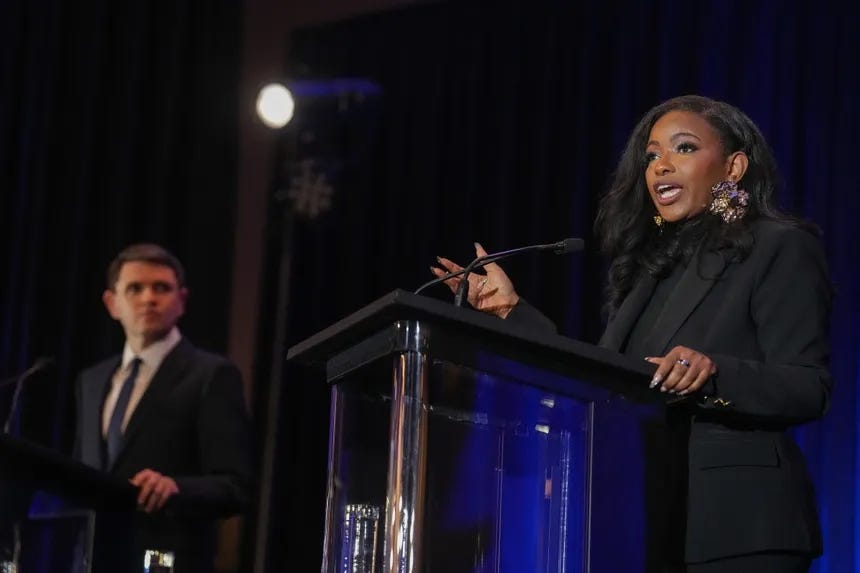
Photo courtesy of Bob Daemmrich for The Texas Tribune via POOL
Before the votes were even counted, the narrative was already written. Crockett was too much — too loud, too confrontational, too risky for a state like Texas.
Too female.
Too black.
Talarico, on the other hand — the former teacher turned seminarian — was reasonable. Winnable. The safe bet. Boring.
A man.
And, white.
I say this because, what the data actually showed, was that every major poll heading into March found the two candidates within a handful of points of each other in hypothetical general election matchups. Voters were saying something different than the party. Not separated by a chasm of viability. Not a blowout waiting to happen. The Republican margin of victory was projected to be virtually identical regardless of which Democrat was on the ticket — one to four points, depending on the poll.
The “electability gap” that justified pushing Crockett out wasn’t in the numbers. It was the racist narrative hammered in people’s heads leading up to voting day.
So what was in the numbers? Talarico’s support was driven overwhelmingly by white voters and men. Crockett’s support came from Black voters, 80% of them, and women. The Lone Rising Star super PAC backing Talarico, whose founder, Alexander Clark, is a close friend of his, ran ads warning Democrats they’d lose in November if Crockett was their nominee. And according to an article written in The Washington Free Beacon, the author Andrew Kerr stated, “Just before the ad blitz, in late January, the super PAC received $500,000 from billionaire Reid Hoffman, a Democratic megadonor who maintained a close relationship with Jeffrey Epstein in the years leading up to Epstein's 2019 arrest for sex trafficking dozens of girls.”
They used dirty money to push fear, not strategy. And fear needs a target. In the U.S., a lot of white people react to perceived demographic change like they're losing something. They are… but it was never theirs. Because proximity to power is not power itself.
Crockett said it clearly, “I am tired of people asking whether or not I am electable. The reality is that that is nothing but a dog whistle.” She was right. The party didn’t actually care. I’ve written about this pattern before, because it isn’t new. We have watched the Democratic Party systematically underinvest in, underestimate, and ultimately waste the time, energy and efforts of black women candidates while telling itself a story about pragmatism.
Pragmatism is how you avoid saying the quiet part out loud. Pragmatism is how you launder bias through polling crosstabs and cable news punditry until it sounds like legitimate strategy.
The tell is always the same. That the scrutiny is never equal.
Talarico entered the race in September with no statewide name recognition and raised over $20 million. Crockett, a sitting congresswoman with genuine national profile, raised $3.7 million in the same stretch. That’s not the market reflecting viability, but rather, a market reflecting who the party’s donor class was comfortable with. There is something clarifying about that sequence if you’re willing to sit with it. This wasn’t a weak candidate failing to connect. The voters who knew her best chose her. The voters who’d been told to be afraid of her didn’t.
Melanin as liability is the actual calculus that got run, cloaked in the language of general election math. A brilliant, qualified woman got passed over not because the data said she couldn’t win, but because enough people decided, on some level they may not consciously examine, that someone who looks like her was too much of a gamble. But, it’s bullshit.
We have been having this conversation for decades. It never seems to land.
Crockett didn’t run a bad campaign. She didn’t collapse under scrutiny. She was sharp, prepared, and she had the receipts. What she didn’t have was the institutional backing that should have been automatic for a candidate of her caliber. The kind of backing that flows easily to men who are newer, less tested, and considerably less threatening to the existing order. That’s the part that has to be screamed from the rooftops. The Democratic Party has a black woman problem. Not in its rhetoric. The speeches are fine. In its choices. In where the money goes. In which candidates get the benefit of the doubt on “electability” and which ones get interrogated for every sharp word they’ve ever said.
Jasmine Crockett called Greg Abbott “Governor Hot Wheels.” She said some Hispanic Trump voters had a “slave mentality.” Those comments became disqualifying talking points. Meanwhile the party gave a standing ovation to a guy who’d never run statewide and whose entire viability argument rested on being white, male, and inoffensive enough not to scare people.
Again, that’s not pragmatism. That’s a safe preference cosplaying as a principle.
I don’t know if Talarico will win in November. I hope he does, because thirty million Texans deserve better than what they’ve got, and this was always bigger than this primary. Crockett herself said as much when she conceded with more grace than the situation required. But I’m not willing to close the books on what happened here and call it a fair fight.
It wasn’t.
The people who pushed the electability narrative — who ran the ads, wrote the op-eds, seeded the doubt — don’t get to walk away clean just because they won. I’m not alone in seeing the pattern. Over a million others see it too. The question is whether the Democratic Party will ever decide it’s worth the discomfort of looking at it directly.
Right now, the party stands for nothing and kneels for everything. They need to grow a backbone. Because so far, the Democratic Party has been one giant disappointment to America.
So what is Jasmine Crockett going to do, now? She is too precious to not be a voice, ideally in Congress. Is she still able to run for the House? I’m hoping that with the disgruntled American voters who are sick and tired of MAGAt Republican crap, she could win despite the redistricting in Texas.
Most people have no problem with a black woman. But a foul-mouthed trash-talking private school girl cosplaying as a ghetto ho is a huge turn off. Too much crossover with the schoolyard fights and cruise liner brawls.