

Every generation of children in modern history outperformed their parents cognitively. Every single one. By design. That was school. Each generation spent more time in formal education than the last, and that investment paid off in measurable ways — in attention, memory, literacy, numeracy, executive functioning, and IQ. The data was consistent and it was clear and it held for decades.
Until Gen Z.
Dr. Jared Cooney Horvath is a cognitive neuroscientist who studies human learning.

In January 2026, he sounded the alarms before congress of what we’ve been ignoring since 2010. That Gen Z is the first generation in modern history to underperform their parents in EVERY cognitive measure we have. Not one metric. Not two. Every single one. And they are going to school MORE than we did. In his written testimony before the U.S. Senate Committee on Commerce, Science, and Transportation, Horvath says without reservation that literacy, numeracy, attention, and higher-order reasoning have all declined — despite increased school attendance and expanded public investment.
I have seen this up close. I spent twenty years in early childhood education, the last many of them as an early childhood education director with a specific focus on curriculum for brain development from birth to five — the foundation of building blocks that is the architecture for the human mind for a person’s entire life. That is the window. The one the research calls critical. The one you do not get back.

Those early years are when the scaffolding goes in — attention, memory, executive functioning, the capacity to regulate and sustain and resist distraction. I watched that neurological groundwork being laid, or rather — neglected, every single day. What Horvath is describing is the downstream consequence of a compromised foundation. I have seen what healthy development looks like from the inside. I know through my own experience precisely what we are hemorrhaging.
More school. Less cognition. The thing that drove improvement for generations is no longer working. Something broke the connection between schooling and cognitive development, and it broke at a very specific moment in time.
If you look at the data (and Horvath did) across more than 80 countries — the pattern is unmistakable. Once a country widely adopts digital technology in schools, academic performance drops. Significantly. Over a quarter of our children are now spending more than four hours on screens during a typical seven-hour school day. More than half spend one to four hours. And less than half of that screen time is spent actually learning anything — students are off-task for up to 38 minutes of every hour they are on a classroom device.
Read that again. Thirty-eight minutes of every hour. Poof! Gone.
The international assessment data confirms what those numbers imply. PISA — the Programme for International Student Assessment, which tracks 15-year-olds across dozens of countries — shows that higher daily screen exposure consistently corresponds to lower scores in reading, mathematics, and science. Not sometimes. Consistently. The relationship is, in Horvath’s word, monotonic: more screen time, lower performance, without exception. TIMSS data, which tracks younger students in math and science, shows the same pattern. PIRLS, the reading literacy study, shows the same pattern. Collectively, these assessments involve millions of students across decades, and they all arrive at the same place.
Take any state’s NAEP data — that’s the National Assessment of Educational Progress, the closest thing we have to a consistent national measure — and compare scores before widespread tech adoption to after. The line goes flat. Then it drops. Like it just fell off a fucking cliff.
Academic research stretching back to 1962 shows steady, progressive cognitive improvement in children. Right up until 2010. Then the line changes direction.
Causation is in the data.
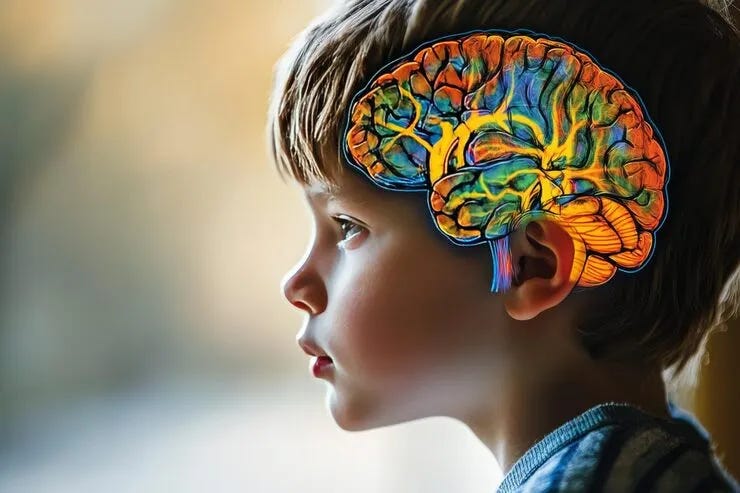
What is happening at the neurological level is that kids skim on screens. It is what screens train the brain to do. Horvath, in his Senate testimony, showed that digital platforms are optimized for rapid switching, novelty, and continuous engagement capture. Even when students are using devices for academic tasks, those devices are cueing the same behavioral patterns practiced during recreational screen use — frequent checking, rapid scrolling, multitasking. The prefrontal control system cannot reliably manage competing goal states without significant performance costs. When attention is repeatedly interrupted, three things happen: time is lost to task-switching overhead, error rates climb from cognitive interference, and memory formation weakens as learning shifts from deep encoding toward habit-based processing.
That is not a parenting problem. That is not a discipline problem. That is repeated conditioning, operating exactly as expected.
Deep reading, the kind that builds comprehension, inference, sustained attention, the capacity to hold a complex argument in your head long enough to evaluate it, requires a different cognitive mode than digital consumption. The research on this is blatantly obvious. When Horvath’s testimony presents the meta-analysis data on reading comprehension, screens underperform paper with a consistent negative effect.
The same holds for writing. Handwritten note-taking reliably outperforms laptop note-taking for long-term learning. Typing encourages verbatim transcription and shallow processing. Handwriting forces summarization, organization, and conceptual encoding. In classes longer than thirty minutes, the gap between handwriting and typing is not marginal — it is substantial.
The thing that pisses me off the most and what drove me to leave education altogether is that, we knew. The research was there. It’s been there. We chose the tools anyway, because the tools were cheaper than teachers, because tech companies spent fortunes lobbying school districts, because “innovation” became the word we used when we meant “cost-cutting” and didn’t want to say so out loud. We fucking knew and blew past the danger zones anyway.
Horvath’s testimony goes further than most are willing to go. He benchmarks EdTech’s effect sizes not against zero — which is the sleight of hand the industry uses to claim small positive results — but against the average impact of ordinary classroom instruction. Against that honest baseline, one-to-one laptop programs don’t just fail to help. They perform significantly below what a regular teacher in a regular classroom achieves without them. Online and distance learning performs worse still.
Horvath says that, rather than deciding what we want children to be able to DO and building education toward that, we redefined education to better suit the tool.
That isn’t progress. That is surrender. And the ones who surrendered weren’t the kids. They are innocent in all of this.
We fucked up.
The institutions surrendered. The administrators who approved the one-to-one device programs. The legislators who funded tech initiatives while cutting reading specialists. The curriculum developers who replaced handwriting with keyboarding and confidently claimed we were preparing children for the future. The parents — and I include myself in this, because I have to — who handed over screens because it was easier than the argument.
We told ourselves we were giving them an advantage. We were, in fact, handing them a cognitive deficit they will spend their lives navigating.
Gen Z didn’t fail. We failed them. Systematically, institutionally, and in our own homes, we prioritized convenience and the appearance of modernity over what the evidence said children actually need to develop their minds.
The research is not vague or up for interpretation. It is not contested in any serious scientific way. What is contested is what we are willing to DO with what we know.
What we are not going to do is wait for the institutions that created this problem to fix it. School boards move at the speed of bureaucracy. Legislatures move at the speed of donors. Tech companies are not going to voluntarily exit the classroom. Nobody who profits from the current arrangement is coming to save your kid.
So here is what you can actually do, right now, that the research supports:
Print it out. Physical books and printed text produce measurably better comprehension and retention than screens. Horvath’s testimony documents a consistent negative effect on reading comprehension when students read from screens versus paper — and that gap widens with text complexity. If your child is reading for learning, it should not be on a device.
Fight for handwriting. Schools that have eliminated handwriting instruction have eliminated one of the most powerful cognitive development tools we have. Handwriting engages the brain differently than keyboarding — it builds memory encoding, fine motor development, and compositional thinking. The data Horvath presented to the Senate shows that in longer class periods, the gap between handwriting and typing grows to a level that should alarm every parent and every school board in America. Demand it back.
Protect boredom. Unstructured time without a screen is not wasted time. It is the condition under which executive functioning, creativity, and sustained attention develop. Your child does not need to be entertained every moment. That discomfort IS the work.
Talk to other parents. Not online. In person. Build the coalition that pressures your local school board, because that is still the level of government most responsive to organized parents who show up. Horvath’s policy recommendations to the Senate include requiring EdTech companies to demonstrate actual learning benefits through independent trials before deployment. That is not a radical ask. It is the minimum standard we require of any drug given to a child. Demand your district hold tech to the same standard.
And if nothing else — if you do nothing else — put the screens away during meals, during the hour before bed, during the car ride. Not as punishment. As protection.
We did this to them. We can start undoing it. It’s not too late.
Horvath’s written testimony to Congress:
https://www.commerce.senate.gov/wp-content/uploads/media/doc/Horvath_Written%20Testimony.pdf
If a paid subscription isn’t in the cards right now, I completely get it — truly. But if you’ve ever read something here and thought “damn, she needs to keep doing this,” you can throw a few bucks in the tip jar over at Buy Me a Coffee.
No pressure. No guilt. Just me, asking nicely, with my hand out like a very earnest raccoon who writes controversial essays.
☕ buymeacoffee.com/eeviebateman
Thank you for being here. Seriously. You make this worth doing.
This is heartbreaking and embarrassing as an adult and parent in this country. If you read this and feel guilty, good. You should. I do. Now, do something about it. Demand we get back to pen and paper reading and writing. Get Chromebooks and their ilk out of elementary schools to begin with. Get active--talk to other parents, to teachers, to school boards.
Thank you for clarifying what some of us thought we saw but we couldn’t be certain how widespread it was. We try and make up the difference while understanding that covid-19 and school shootings presented challenges now artificial intelligence is taking them on yet another spin. Parents are a bit distracted because Trump is robbing US blind and removing our rights. The trillionaires don’t want us to make our way through this multilevel attack.