

I spent twenty years as an Early Childhood Education Director before leaving the education field for good in 2022. It was both the most rewarding and the most heartbreaking experience I’ve ever had—one I witnessed and actively took part in every day. My work centered on the earliest years of life, from birth to age five, the most critical stage of development. These first five years form the foundation children will build on for the rest of their lives. I was proud to be a part of that moment in their little lives.
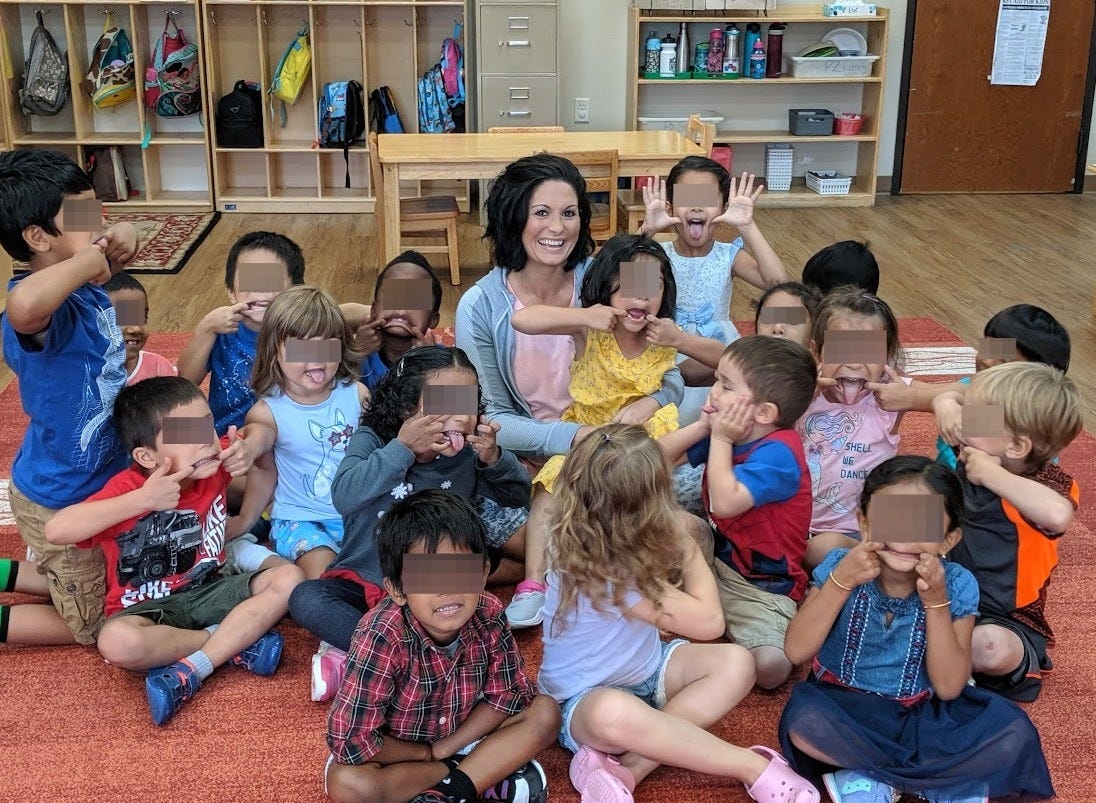
I loved watching them grow and change. Not gradually, the way children are supposed to change—growing into language, into impulse control, into the slow and beautiful messiness of learning how to be a person. This change was different. It was a reversal.
And by the time most people noticed it, we had spent a decade arguing about whether it was even real. Oh, it’s real. I watched it happen firsthand, and over the past fifteen years, research has finally begun to confirm what teachers already knew. We just didn’t have the language for it yet. What I had was gut instinct and twenty years of knowing what children are supposed to look like when they’re developing correctly. That’s not nothing—but it’s not enough when you’re standing in front of parents and administrators who want data. It was one of the most frustrating stretches of my career, knowing something was deeply wrong and not yet having the science to prove it.
But then, a 2010 longitudinal study published in JAMA Pediatrics, the first of its kind in the United States, followed 259 infants from six months of age through their fourteenth month. By six months, 96% of those babies were already being exposed to screens, averaging nearly two and a half hours daily. When researchers measured cognitive and language development eight months later, longer duration of media exposure at six months was directly associated with lower cognitive development and lower language scores at fourteen months.
Those children aged into my classrooms right around 2010.
I didn’t know about this study then. I just knew something had shifted. The data had already named it. When I started in early childhood education in the early 2000’s, the diagnostic landscape looked a certain way. ADHD existed. Anxiety existed. Autism existed. But the volume was different. The urgency was different. Over the course of my career, I watched those numbers climb, quadruple even, in ways that couldn’t be explained by better screening alone.
A National Survey of Children’s Health spanning 2018 to 2020, covering over 100,000 children, found that excessive screen time was positively associated with behavioral and conduct problems, developmental delay, speech disorders, learning disabilities, autism spectrum disorder, and ADHD, and that there were significant dose-response relationships.
Dose-response.
That means the more screen time, the more damage. It’s not coincidence. That’s cause and effect. The science is solid. The research on Autism Spectrum Disorder (ASD), specifically, is uncomfortable for people who want clean, simple answers. A systematic review examining early screen exposure and ASD risk found that the longer the period of screen exposure, the higher the risk that a child may develop ASD-like symptoms, and the earlier the child is exposed to screens, the higher that risk becomes compared to children exposed later or never. That finding is sitting in peer-reviewed literature right now. We’re just not talking about it loud enough.
And then there’s ADHD. A meta-analysis of nine studies covering over 81,000 children found a positive correlation between screen time and ADHD risk, with children who spent two or more hours per day on screens showing 51% higher odds of an ADHD diagnosis compared to those who spent less than two hours.
Fifty-one percent!
A separate study found that five-year-olds who spent more than two hours in front of a screen had 7.7 times the likelihood of meeting criteria for an ADHD diagnosis compared to children who watched less than thirty minutes per day. That risk outranked sleep deprivation, socioeconomic status, and parental stress as contributing factors.
Read that again. Screens outranked poverty as a risk factor.
Let’s talk about blue light, because this is where the physiological damage gets granular and people need to take this more seriously than they do. Research has shown, not suggests, it has definitively shown, that children’s melatonin levels are suppressed twice as much as adults’ when exposed to the same level of artificial light. Their brains are more vulnerable. Their circadian systems are more plastic. Which means every tablet handed to a toddler before bed is doing twice the neurological damage to that child as it would to you. Magnetic resonance imaging scans have revealed reduced cortical thickness and volume in frontal lobes — the regions essential to attention, memory, and complex processing — after just a few nights of curtailed sleep. A few nights. This isn’t a long-term slow burn. This is acute. This is immediate.
Prolonged screen exposure impairs attention, memory consolidation, and emotional regulation in children, according to researchers studying the intersection of blue light and cognitive development. The prefrontal cortex, the part of the brain responsible for impulse control, decision-making, and self-regulation, is being robbed of the sleep it needs to develop. And we, as parents, handed children the tool that’s robbing it, and then sent them to school and asked their teachers to fix it. And nobody wants to admit that it wasn’t the classroom that failed these children. Parents did.
Not out of malice—out of convenience, exhaustion, and a culture that handed them a luminous pacifier to help them. Both parents are working. Many are working more than one job. The cognitive and emotional load of modern parenting on top of financial survival is genuinely crushing, and the device is the cheapest, most available babysitter that has ever existed.
But we also have to be honest about what that device is.
It was engineered by behavioral psychologists and neuroscientists paid specifically to make it impossible to put down. The same dopamine manipulation rewiring the child’s brain is rewiring the parent’s. They are not weak. They are outmatched. Nobody warned them. Pediatricians weren’t sounding alarms at well-child visits in 2010.
Pre-technological boom gen-X and older millennial parents were doing it.
The tablet arrived pre-marketed as an educational tool. LeapFrog, PBS Kids, learning apps—they gave parents the genuine belief they were doing something enriching while they got dinner on the table. And when the toddler melted down, the device stopped the screaming instantly. That kind of immediate relief is its own reinforcement loop. Parents got hooked on the quiet just as surely as the child got hooked on the screen.
Teachers spent years, many of them decades, mastering a pedagogical model built around children who could sit, attend, regulate frustration, follow multi-step directions, and tolerate delayed gratification. By the mid-2000s, that child was increasingly rare. By the 2010s, teachers were standing in front of rooms full of kids whose dopamine systems had been trained by algorithmically optimized content to expect constant stimulation, instant reward, and zero productive friction. The old model that has direct instruction, independent work, linear thinking tasks, sustained reading, was a foreign language to a growing percentage of the children sitting in those seats.
A Stanford professor of education, Antero Garcia, eventually put into academic language what teachers had been screaming into the void for years. Every device in a classroom is a decision—a decision to spend money on technology instead of the teacher standing in front of it. And every time we hand a struggling student a tablet instead of a trained human being, we are telling them they no longer hold value in education. School administrators abandoned legitimate teaching for destructive innovation.
The Education Directors were handcuffed to policies and practices that they had no say in. The teachers knew they were fighting an uphill battle. They knew before the research confirmed it, before the administrators wrote the memos, before the consultants came in with their engagement frameworks. They knew because they were watching children who could not hold a pencil long enough to finish a sentence, who melted down at the word “wait,” who had no language for boredom because they had never been required to survive it.
And then the parents came.
Parents whose children had been given unfettered access to screens from infancy came to parent-teacher conferences and demanded to know why their child wasn’t reading on grade level, wasn’t sitting still, wasn’t performing. They demanded intervention plans, accommodations, diagnoses—anything that would explain the gap between expectation and reality without requiring them to look at the iPad on the kitchen counter.
Teachers were blamed for failing to reach a child the system was never designed to serve in the child’s current neurological state. The question was never “what is the environment doing to this child.” The question was always “what is the teacher doing wrong.” That’s not an indictment of parents as people. It’s an indictment of a culture that normalized handing a child a glowing rectangle because the alternative required patience we had collectively decided we didn’t have time for.
It’s easier to believe the school is broken than to believe you are the variable.
Neuroscience journalist and biochemist Michaeleen Doucleff, who spent years researching the dopamine system in children, found something that reframes the entire conversation. He found that dopamine doesn’t give us pleasure.
It makes us want.
Modern technology splits the wanting from the satisfaction, leaving children in a state of perpetual craving that never resolves into contentment. We didn’t give our children joy. We gave them hunger. And then we put them in a classroom and asked them to stop being hungry.
So. What do we do now.
First, we stop. We don’t “limit” screens in the way we use that word—casually, with loopholes, with screens still present at every meal and bedtime and car ride. We stop. No screens before age two, period. The American Academy of Pediatrics said it. The World Health Organization said it. We just didn’t listen. For children two through five, the recommendation is one hour of high-quality, co-viewed content. Not background TV. Not solo YouTube. One hour, together, with a parent. Children’s eyes and brains are significantly more photosensitive to blue light than adults’—their lenses do not yet filter high-energy wavelengths the way mature eyes do. Screens go off at least one hour before bed. Not thirty minutes. One hour. This is a hard rule, not a negotiation.
Second, we replace. The dopamine system is flexible, even in teenagers whose brains have been marinating in algorithmic stimulation for years. We can rewire it — not by taking things away, but by linking real-world activities to the same fundamental needs that screens exploit: adventure, autonomy, physical challenge, social belonging. This is not a metaphor. This is neuroscience. The brain will learn to want what it is given. Give it something worth wanting. A systematic review of 186 studies found that high levels of screen time were associated with depression, anxiety, and poor self-regulation in children, while time in nature was associated with positive mental health, cognitive functioning, and academic achievement, and some evidence indicates that nature can buffer the negative consequences of high screen time.
Put your kids outside. Not with a plan. Not with a lesson. Outside, unstructured, in whatever weather exists where you live. I’m a firm believer that there is no such thing as bad weather, just bad clothing. Let them play in the rain. If it’s cold, bundle them up. If its hot, sunscreen and find shade. Let them be bored. Let them solve it themselves. That’s where critical thinking is born— not in an app, not on a screen, not in a classroom. In boredom. In the uncomfortable space between wanting something to do and having to invent it.
Third, we tell the truth to our children’s schools. If your child has had significant daily screen time for most of their life, their teacher needs to know that. Not as a confession. As data. Teachers cannot remediate what they don’t understand.
Fourth, we model it ourselves. Teenagers, according to researchers, actually want their parents’ help with this. They want guardrails. They’re afraid to ask because they don’t want their phones taken away. It needs to be collaborative, not “we’re doing this,” but “I want help with my own screen usage. Can we do this together?” You cannot ask your kid to put the phone down while yours is in your hand.
That’s not parenting. That’s theater. Do as I say, not as I do, doesn’t work.
The children didn’t change because something went wrong inside them. They changed because we changed the environment and then acted surprised when the organism adapted. Genetics don’t shift in a generation. Environments do. We built a world saturated with artificial light, instant reward, and algorithmic stimulation, handed it to children before their brains were formed enough to resist it, and are now diagnosing the results as disorders. Some of those diagnoses are real. Some of those children have genuine neurological differences that exist independent of any screen.
But we are also, absolutely, creating pathology through environment. And we can, slowly and with effort, create something else. The brain is not fixed. It is built by what it does repeatedly. For years, we let the algorithm decide what that was.
It’s time to get our children back on track.
I have a video someone took of me years ago. It's nothing remarkable to look at. A room full of small children singing happy birthday to their director, off-key and completely sincere. I watch it sometimes when I need to remember why any of this matters. Those teachers loved those kids. Those kids loved being there. Nobody was staring at a screen. Nobody was dysregulated. Nobody needed a diagnosis to explain why they couldn't be present. They just were. That's what we're fighting to get back. Not a policy. Not a framework. That room. Those voices. That moment.