

Stop telling me it can’t be done. I pay my taxes online. I bank online. I filed for unemployment online during a global pandemic while the entire government infrastructure was on fire. We have figured out how to move enormous amounts of sensitive, high-stakes information through digital systems with reasonable security. The Epstein files are digitally secured. The idea that voting, the single most fundamental act of democratic participation, is somehow too delicate for the internet is not a technical argument. It is a political one. And I’m tired of governmental leadership gaslighting us like it’s a fuckin’ science.
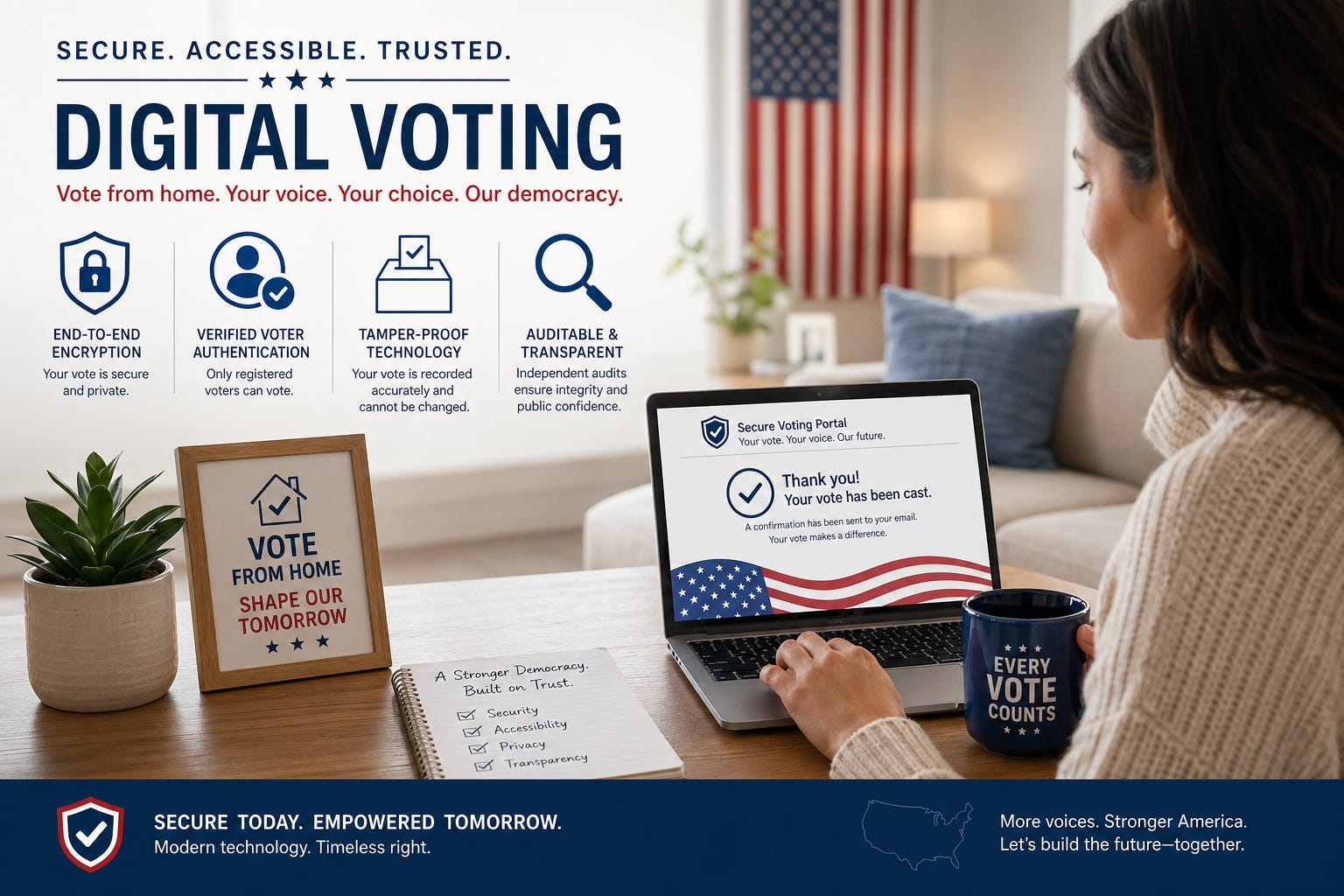
Yes, there are real challenges. I’m not pretending the engineering is trivial. But “hard” and “impossible” are not the same word, and the people that have been in power the last 20 years are the culprits who have a vested interest in making sure we stay asleep just enough not to notice the difference. Lower turnout protects incumbents. Barriers to voting protect the people those barriers were designed to protect. So when someone tells you digital voting can’t be secured, that it’s impossible, the first thing you should say to them is, “I was born at night, but not last night asshole.”
Here’s what a real system could look like. A functional, buildable framework using technology that already exists, most of it in active use somewhere in the world right now.
How We Actually Build This
Step One: Identity Verification
Multi-factor authentication using government-issued ID cross-referenced against your voter registration, biometric confirmation matched to your DMV or passport photo, and a one-time code sent to your verified phone or email. This is the same stack the IRS already uses. It is not exotic. It is not new. We verify identity digitally for things far more consequential than this every single day.
Step Two: Cryptographic Anonymization
This is the hard part, and it has a real solution. When you authenticate, your identity gets mathematically separated from your ballot before the vote is recorded, using something called a zero-knowledge proof. You can prove a registered voter cast this ballot without revealing *which* voter. This technology exists. It’s used in blockchain privacy applications today. It needs serious development and independent auditing to work at national scale, but it is not theoretical. It is a real thing that real engineers have built. If NASA can put whitey on the moon, we sure as hell can get this done.
Step Three: Tamper Detection via Cryptographic Receipt
Every vote gets a unique cryptographic fingerprint the moment you submit. You receive that fingerprint as a receipt. You can verify your vote was recorded exactly as you cast it — without revealing what you voted. If anything changes between your screen and the server, the fingerprint doesn’t match. This is auditable without being traceable. It gives voters a way to independently confirm the integrity of their own ballot.
Step Four: Re-Vote Protection Against Coercion
Someone is worried about an abusive partner standing over a voter’s shoulder? Valid concern. It’s the same problem mail-in ballots have. The solution isn’t to abandon digital voting, it’s to build in re-vote capability. You can change your vote as many times as you want until polls close. Only the last submission counts. Someone forces you to vote a certain way? Fine. You pick up your phone an hour later after the controlling asshat leaves and change it. No one can ever prove what your final vote was. Estonia, a country in Northern Europe already does a version of exactly this.
Step Five: Decentralized Infrastructure
No single server. Votes are distributed across a decentralized ledger with multiple independent nodes run by different entities: state governments, universities, nonpartisan organizations. Every single one would have to be compromised simultaneously for the system to fail. This eliminates the single point of catastrophic attack. It also eliminates the single point of catastrophic trust. You don’t have to believe the federal government is honest. You have to believe that all of them are dishonest at the same time.
Step Six: Open Source Everything
The entire codebase gets published publicly. Every line of it. Thousands of independent security researchers, academics, and adversarial hackers try to break it constantly and in the open. Vulnerabilities get found and fixed transparently, not hidden by a private vendor protecting a government contract. The security of this system cannot belong to a corporation with a profit motive. It has to belong to everyone. This supports a culture of accountability.
The one remaining problem that we can’t control, is the devices people vote from. Malware on a personal laptop, a keylogger, or a vote-altering browser extension, are real threats that exist on the voter’s end, not the server’s. However, mitigations exist. A dedicated verified voting app, a live-boot USB that runs a clean secure environment, or publicly available kiosks that give home-level convenience with controlled hardware. None of these are perfect. All of them are better than what we have now.
The technology stack to build this exists right now, in pieces, waiting for some smarty-pants with the will to assemble it. What doesn’t exist is the political will to fund it, the bipartisan trust required to implement it, and a vendor-neutral public infrastructure to run it. Those are not engineering problems. Those are power problems.
The people who benefit from suppressed turnout have spent decades calling digital voting impossible. They have funded bullshit studies that side with the opposition. They have commissioned reports. They have sent very serious “smart” people on television to explain, with great patience, why regular people cannot be trusted to vote from their couch the same way they order groceries.
Meanwhile, forty-seven million Americans didn’t vote in the last presidential election and we got stuck with, who Jon Stewart refers to as, Fuck-Face Von Clown Stick. Millions more voted under conditions, like standing in long lines, limited polling locations, and inflexible work schedules. All of which function as de facto poll taxes. We are not talking about a minor inconvenience. We are talking about a system that structurally silences specific populations under a pretend democracy.
And before anyone opens their mouth about the cost: save it. This is the same government that found billions for a war nobody voted for and millions to renovate a ballroom in the people’s house. The same administration that can mobilize federal funding overnight when the right people want something has somehow never managed to scrape together the resources to make voting easier for ordinary Americans. It’s not a budget problem, it’s a priority problem. And the priorities tell you everything you need to know about who the United States government actually works for.
It isn’t impossible. It is expensive, complicated, and politically inconvenient for the people currently holding the keys. That is a very different thing. And we should really stop leaning into that narrative pretending otherwise.
If a paid subscription isn’t in the cards right now, I completely get it — truly. But if you’ve ever read something here and thought “damn, she needs to keep doing this,” you can throw a few bucks in the tip jar over at Buy Me a Coffee.
No pressure. No guilt. Just me, asking nicely, with my hand out like a very earnest raccoon who writes controversial essays.
☕ buymeacoffee.com/eeviebateman
Thank you for being here. Seriously. You make this worth doing.
Here in Brazil, it's been working for a long time. And we get results in up to 2 hours after regional voting and 6 hours after national voting. Approximately.
Yes! Years ago, Democrats wanted a National Voter ID system (which isn't what SAVE Act promises to be). We certainly have the technology now to secure voting and ensure the 1 thing the U.S. Constitution requires ("1 person, 1 vote). Such a system would allow an eligible voter to vote anywhere and still reasonably know that they vote only once in his/her home state. The only reason to oppose it is that wealthy people often own multiple homes across multiple states. To them, they may be inclined to vote in multiple jurisdictions. This credible use of technology would stop that nonsense, full stop.