

On June 18th, four days before the 27th anniversary of one of the most important civil rights decisions most Americans have never heard of, a DOJ lawyer named Lanora Pettit wrote a memo. In it, she argued that Olmstead v. L.C. — the 1999 Supreme Court decision that said the state cannot warehouse disabled people in institutions when they could be safely supported in their own communities — never actually meant what every court, every administration, and every disability rights lawyer in this country has understood it to mean for almost three decades.
Huh? OK, bitch. WTF.
She admitted, in her own memo, that her reading is out of step with how federal courts understand the decision. Buried in the document itself, Pettit concedes that her interpretation runs counter to the common understanding of Olmstead within the federal courts. She wrote a 39-page legal opinion, on the record, admitting that virtually every circuit court that has touched this issue for the last two and a half decades would disagree with her.
Normally that admission would kill a legal opinion in its crib. The whole point of an OLC memo and the only reason it carries any weight at all, is the fiction that it’s a defensible reading of the law. Something a court could, in theory, look at and go, “sure, I can see that.” It’s what lets federal officials turn around later and say we relied on this in good faith, the exact shield Mukasey pulled out for the CIA guys who waterboarded people. We were just following the memo.
But you don’t get to claim good-faith reliance on advice you already knew was bullshit. That defense requires you to not know better. And Pettit knew better. She put it in writing. Her own memo torches her own alibi before anyone else even has to.
And the evil twat sent it anyway.
I think this is the true story and I want to talk about it. Because everyone covering this story is treating it like a disability rights story, and it is one, but it’s also something else, if you know where to look. Lets take a trip down, follow-the-money-lane, shall we?
This is the Bybee memo reimagined.
In 2002, DOJ lawyer John Yoo drafted a memo, signed by Assistant Attorney General Jay Bybee, that gave the CIA legal cover to waterboard people. Jack Goldsmith, who later ran that same office, withdrew it and called the legal reasoning deeply flawed and sloppily reasoned. Years afterward, Attorney General Michael Mukasey told Congress that DOJ could not prosecute anyone who’d relied on a Justice Department opinion, even one later proven wrong. That’s the part that matters here. The memo doesn’t have to be correct. It just has to exist long enough for someone to act on it.
That is the entire function of an Office of Legal Counsel opinion. It is not law. It does not go through Congress, it does not go through public comment, it rarely survives contact with a courtroom. It is a permission slip, written by the President’s own law firm, for the President’s own agencies, to do something the actual law does not allow. And the genius of it — the way you’d call a man genius for finding an elegant way to rob you — is that, by the time anyone successfully challenges it, the policy built on top of it has already reshaped the ground under millions of people.
So forget Olmstead for a second. Watch the sequence.
In July 2025, Dipshit Tronald Dump, signed a cruel executive order called Ending Crime and Disorder on America’s Streets. It blamed homeless people for vagrancy and violence in American cities and called for shifting them into long-term institutions through what it called the appropriate use of civil commitment. It explicitly directed the Attorney General to pursue the reversal of any legal precedents standing in the way.
That order had a problem though. You guessed it… Olmstead.
With decades of case law sitting on top of it. Olmstead was one of those precedents.
Eleven months later, OLC hands them exactly the tool the order asked for. A memo says, actually, Olmstead never required community-based care in the first place. The obstacle the executive order named is now legally, if not factually, gone.
Where it stops being a civil rights story and becomes a financial one — because somebody has to actually run the institutions people get committed to, and that business isn’t run by the state anymore.
It’s run by, again, you guessed it… private fuckin equity.
Acadia Healthcare operates more than 50 inpatient psychiatric hospitals and is the largest methadone clinic chain in the country. It was built by the private equity firm Waud Capital Partners, which took it public in 2011 with a controlling stake and board-designation rights. Waud has since sold down most of that position — Acadia is now a widely held public company, and as of last year its own board and executives collectively owned barely one percent of the stock. But founder Reeve Waud still chairs the board, and the company he built runs on the extraction logic private equity built into it from day one. In 2023 it pulled in 2.9 billion dollars in revenue — 69% of it from Medicare and Medicaid, meaning your tax dollars are the business model. The New York Times spent months investigating whether Acadia was holding patients against their will to keep insurance payments flowing. Acadia and its biggest competitor, Universal Health Services, together account for roughly half of every psychiatric hospital in the country cited for violating federal emergency treatment law over the last fifteen years.
Holy fuckballs batman.
In Dallas, Perimeter Behavioral Health, who is backed by Ridgemont Equity Partners, a private equity firm that has invested more than 4.4 billion dollars since 1993, acquired its Dallas and Arlington hospitals in 2019 from SAS Healthcare, a company that had just been criminally indicted for violating the Texas mental health code. In August 2023, federal regulators found that Perimeter’s Dallas facility refused to examine a patient who’d just attempted suicide.
Private equity now owns 14% of all freestanding psychiatric hospitals in this country, damn near double what it owned in 2013. In Louisiana, that number is 38%. In New Mexico, three of the state’s four psychiatric hospitals are private equity-owned. These are bed counts, not abstract numbers, and beds are the only unit of measurement these companies actually care about.
What’s actually happening once you strip away all the legal throat-clearing is that a memo, whose own author admits is horseshit, hands an executive order the legal cover it was missing. That’s it. That’s the whole trick. An executive order that was written explicitly to shove more people into institutions against their will just got handed the permission slip it needed, from a lawyer who told you in her own document that she doesn’t believe it either.
And the institutions lining up to take them aren’t run by the state anymore. They’re run by the same investors who have spent the last decade turning psych beds into yacht payments. The same ones who’ve already been caught holding patients longer than medically necessary, who’ve already been caught refusing to examine a man who just tried to kill himself, who’ve already paid out settlements for exactly this. That’s who’s waiting on the other side of this dangerous and irresponsible memo.
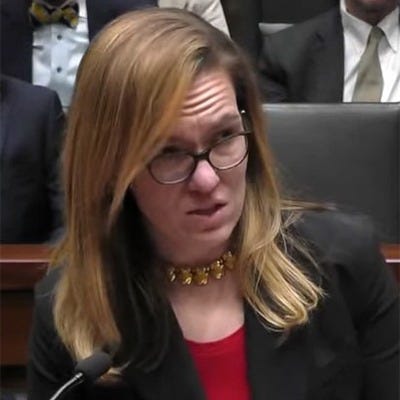
Don’t forget the name Lanora Pettit. Remember her face. This is her horror to own…
So don’t let anyone tell you this is a wonky legal afterthought. It’s a supply chain. Discredited memo, to executive order, to a bed owned by a firm that bills your tax dollars while it decides how long to hold you hostage.
Nobody profits when disabled people stay in their own homes. Quite a lot of people profit when they don’t, including Lenora Pettit. Stand up for the disability community. They need support more than ever right now…
Peace and love… xoxo ~Eevie
"Unjustified institutional isolation of persons with disabilities is a form of discrimination." ~Justice Ruth Bader Ginsberg from the the actual Olmstead v. L.C. majority opinion
If a paid subscription isn’t in the cards right now, I completely get it — truly. But if you’ve ever read something here and thought “damn, she needs to keep doing this,” you can throw a few bucks in the tip jar over at Buy Me a Coffee.
No pressure. No guilt. Just me, asking nicely, with my hand out like a very earnest raccoon who writes controversial essays.
☕ buymeacoffee.com/eeviebateman
Thank you for being here. Seriously. You make this worth doing.
This is pure evil as well as end-stage capitalism in its purest form. They’re getting desperate for new revenue streams so they’ll consume their own host to find any remaining profit:
"The final stages of capitalism will be marked by global capital being unable to expand and generate profits at former levels. Capitalists will begin to consume the government along with the physical and social structures that sustain them. Democracy, social welfare, electoral participation, the common good and investment in public transportation, roads, bridges, utilities, industry, education, ecosystem protection and health care will be sacrificed to feed the mania for short-term profit. These assaults will destroy the host."
— Chris Hedges
The clearest turning point was the U.S. Supreme Court’s June 28, 2024 decision in City of Grants Pass v. Johnson. The Court ruled that cities could enforce public camping bans against homeless people without automatically violating the Eighth Amendment’s ban on cruel and unusual punishment. In practice, that opened the door for more fines, arrests, jail threats, and forced removals of people who often have nowhere else to sleep.
Then, in July 2025, the Trump administration issued an executive order called “Ending Crime and Disorder on America’s Streets.” Its language links homelessness, public disorder, mental illness, addiction, camping, loitering, and crime, and it pushes federal agencies toward enforcement, involuntary treatment, and institutional settings rather than a housing first approach. Disability and homelessness advocates have warned that this risks turning poverty, illness, trauma, disability, and lack of housing into reasons for confinement rather than reasons for support.
The disability law part is especially serious. Since the 1999 Olmstead decision, the principle has been that people with disabilities should receive services in the most integrated community setting where appropriate, rather than being unnecessarily segregated in institutions. That was a major civil rights gain. But a recent U.S. Department of Justice memo, dated June 18, 2026, argues that the ADA and Rehabilitation Act do not impose the same kind of “integration mandate” many advocates have relied on for decades. Advocates are warning that this could weaken federal protection against unnecessary institutionalisation.
So ethically, I agree with you: this is deeply troubling. A society should not respond to homelessness by making sleep illegal. It should not respond to disability by making institutions easier than community care. And it should not respond to mental illness or addiction by dressing coercion up as compassion. There will always be cases where someone is in immediate danger and urgent care is needed, but that is very different from building a broad policy system where the poor, disabled, addicted, traumatised, and mentally ill are removed from public view because the state will not fund housing, health care, disability support, or community services.
To me, the moral line is this: care should expand a person’s life, not disappear them from society. What America seems to be doing here is shifting responsibility away from housing and support and toward police, courts, jails, and institutions. That is not progress. That is a return to the old idea that vulnerable people are a public nuisance to be managed, rather than human beings with rights, histories, families, bodies, pain, and dignity.