

I first heard of George Carlin in 1992, when I was eleven. My mother and her husband had managed to get tickets to see him, which was no small event in our quiet corner of Michigan’s Upper Peninsula, where very little ever came through town. I can still hear the thrill in my mother’s voice, the way excitement made her sound younger. It caught my attention. Whoever this man was, he mattered.
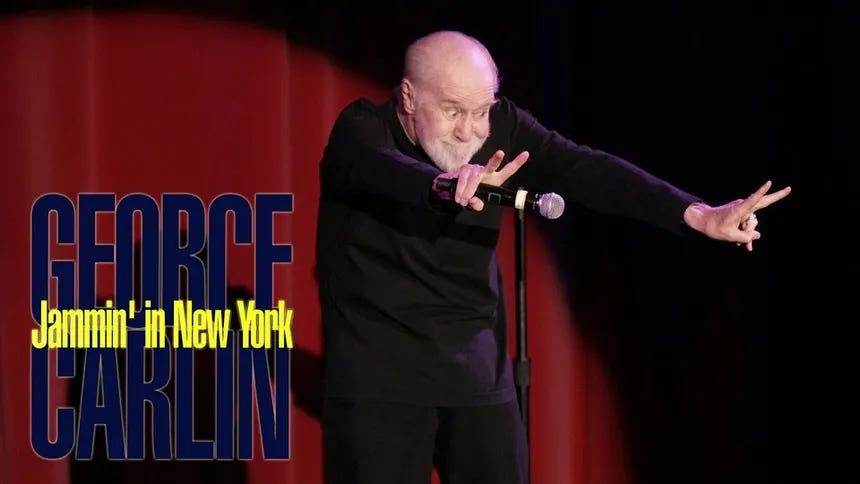
Curious, the night of his performance my mother went to watch, I went to Blockbuster and rented one his special called, Jammin’ in New York. I remember sitting there, completely unglued by laughter, the kind that feels almost shocking at that age. I had always been a bit of an old soul and understood more about the world than a typical pubescent eleven year old. But, that was the first time I’d heard comedy that sharp, that fearless. He was so poignant in his delivery and the words he used made so much sense, even an eleven year old got the message.
He did a bit about airline language, “near miss” versus “near hit”, and I laughed harder than I ever had in my life. He had a way with words that tickled my brain. The next day, I couldn’t wait to talk to my mom about it. “Mom, how was the show?” I asked, expecting to meet her excitement where I had found it. We didn’t bond much and anytime I could find an opening, I’d try to step through the door. But she shrugged it off. “Meh, it was funny,” she said, “until he started doing the political crap.”
My mother was a conservative. So was her husband. Something tells me she was only conservative because he was. She wore her patriarchal white woman hat most of the time, but every once in a while, I’d see the girl who desperately wanted to take it off. So, her answer made sense. But it also landed differently now that I had heard him myself, because what the fuck was she talking about? For me, the “political crap” was inseparable from what made him brilliant.
Isn’t that the whole George Carlin story, really. The conversation that happened right there in my mother’s living room? The people who laughed until the truth showed up and then decided they didn’t like comedy anymore?
He Was A Diagnostician In Comedy
The thing I think people get wrong about Carlin is that they think he was a comedian who got political. He wasn’t. He was a diagnostician who used comedy as the delivery system because if he’d just stood there and told you the truth, you would have changed the channel. His jokes, however brilliant, weren’t the point. The jokes were the spoonful of sugar he fed us. The medicine was that you’ve been lied to your entire life and we help the assholes in Washington do it over and over and over again.
His “Soft Language” routine should be required listening for every breathing American. That was the bit on the language, war, brought us. Like, “Shell shock.” Two syllables. World War I. You hear that and you know something broke inside a human being. The he said, by Vietnam, the same condition had become “post-traumatic stress disorder” — four words, clinical and distant, the actual suffering already starting to disappear behind the paperwork. And he wrapped it up by saying the Gulf War, was “operational exhaustion.”
He clocked all of it.
Every step the language took away from the reality, he followed it and dragged it back into the light. “Pre-owned vehicles.” Not used cars — pre-owned. “Correctional facility.” Not prison. “Collateral damage.” Not dead children. Carlin understood that when when you launder the language, you launder the crime. And we let them do it because the softer words feel better in our mouths. He said we don’t die, but rather now, we “pass away.”
He wouldn’t let it feel better and used humor as the delivery system. I loved him for that. As someone who grew up in abuse, surrounded by secrets, people like George Carlin were beacons of light in my dark world. And laughing about it made it feel not so damning. He made it digestible.
Then there’s the “owners” bit from his 2005 special “Life is Worth Losing”, and if you haven’t watched it recently, watch it tonight, because it sounds less like a comedy routine and more like a warning we ignored and continue ignoring. He stood there in all black and told the audience, flatly, that there is a club. That you and I are not in it. That they want us just smart enough to run the machines and just dumb enough not to ask why the machines are running us. That the table is tilted and the game is rigged and everybody knows it, and nothing changes because the people who could change it own the people who would have to change it.
“It’s called the American Dream, because you have to be asleep to believe it.”
He wasn’t just doing a bit. He was telling hard truths we keep gaslighting ourselves into believing aren’t happening.
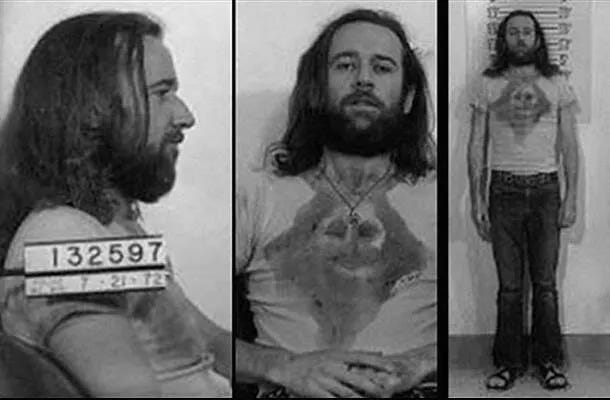
The Seven Dirty Words routine, which got him arrested in Milwaukee in 1972 and eventually put his name on a Supreme Court case, was never about profanity. It was about who gets to decide what’s dangerous. Who decides which words are off-limits and why, while the actual dangerous shit — the wars, and the poverty, and institutional rot — gets regurgitated in clean language and broadcast at full volume. He went to court over a comedy routine and left a mark on First Amendment law that’s still there. With jokes. About swearing. Think about that for a second. It’s crazy.
The man never wasted a minute on stage. Every bit was doing two things at once.
The Best of George
He hosted the very first episode of Saturday Night Live in 1975. First one. He was there at the birth of the institution that would shape American political comedy for the next fifty years, and he was already the sharpest person in the room. Five Grammy Awards. Fourteen HBO specials. More than twenty albums. Over one hundred appearances on Johnny Carson’s Tonight Show — which, if you do the math, means Carson had him back roughly every three-four weeks for decades, because you don’t let go of someone who makes your audience that alive. Comedy Central ranked him the second greatest stand-up comedian of all time. Behind Richard Pryor, ahead of Lenny Bruce. That is the correct order, and he would have said so himself.
His book “Brain Droppings” hit the New York Times bestseller list. Because of course it did. The man could write. His notebooks were legendary and he kept everything, catalogued everything, treated the work like it was the holy grail, because it was. When he talked about performing, he described it like conducting. He was standing up there pulling the laughter out of the room, directing it and shaping it. For someone who claimed to find people exhausting, he needed an audience like most people need air.
His Not So Greatest Moments
But, like any human being trying to navigate this finite amount of time we have on this earth, Carlin had his not-so-great moments. The 1970s almost killed him. Not metaphorically. His cocaine use got so heavy it damaged his health, gutted his creativity, and caused him to blow off his taxes for years until he owed the IRS a number that took him close to twenty years to fully pay back. “I lost years,” he said later. “I could have been a pole vaulter in those years.”
He wanted to be an actor — that was the dream, and he tried it and was, by his own account, absolutely terrible. Fluffed lines, panicked, lost. The debt killed the acting career before it started, chained him to the road, and the road, in the end, made him one of the greatest comics who ever lived.
In essence, the IRS accidentally saved his legacy.
His first heart attack was in 1978. The second was in 1982 at a Dodgers game — he was a Mets fan, had been since the Dodgers bailed on Brooklyn, a betrayal he nursed for decades, and the doctors treated him with an experimental drug they’d literally gotten that week. It worked. His third heart attack came later.
In 2004, at sixty-seven, he checked himself into rehab for wine and Vicodin dependency. Nobody told him to. He saw it coming and went. “I could easily have continued functioning for a while,” he said. “But my use would have progressed. I didn’t want to tolerate that.” Self-aware to the end.
His first wife Brenda, who had been with him since 1961, who produced most of his early HBO specials, who helped discover Garry Shandling and Paul Reubens and built a career in her own right, died of liver cancer on May 11, 1997. The day before his sixtieth birthday. Thirty-six years together. She had walked through everything with him, including the years that were genuinely ugly.
His daughter Kelly has written about growing up in that house. She spoke about having to read her parents’ moods like weather systems, writing what she called a UN-style peace treaty trying to keep the cocaine and the drinking from destroying what was left. Carlin never pretended that chapter didn’t happen. He owned it. He was leveled when Brenda died.
Six months later he met comedy writer Sally Wade, fell immediately and terrifyingly in love, panicked, and ran. Eventually he stopped running. They married in 1998 and stayed married until he died… two days before their ten-year anniversary.
He Kept His Personal Life Close to His Chest
Carlin almost never talked about his personal life on stage. This shocks people because he felt so intimate, so known. His daughter Kelly said audiences used to call him “like my uncle” that they felt close to him. But he kept himself off the stage almost entirely. Except for his “Class Clown” bit in 1972, which was rooted in his Catholic school childhood in Morningside Heights, the personal stuff stayed personal. What you got was his mind, his rage, his precision. Not his diary.
He was also the narrator of Thomas the Tank Engine. The American version, 1991 to 1995. George Carlin, the man who went to the Supreme Court over profanity, who told America it was being managed by owners who despised it, did the voice of the Conductor for a children’s train show. Kids who spotted him in airports expected a small man in a uniform. They got a large man with a grey ponytail who had nothing in common with anything they’d seen on television. He found this funny.
When I began my family, my boys were hooked on Thomas the Tank Engine. They had every train. And it was one children’s show I didn’t mind sitting through with them. His voice gave me comfort and I’d giggle sometimes imagining him saying things like, “Here comes Thomas chugging down the fuckin track.”
He described his relationship to people as, “I love and treasure individuals as I meet them. I loathe and despise the groups they identify with and belong to.” He loved humans. He had zero patience for humanity. He didn’t think that was a contradiction, and honestly, neither do I. He loved dogs because they don’t perform. They don’t pretend what they want or sanitize it for your comfort. They just ARE, fully and without apology. He respected the hell out of that. I’m with him. We don’t truly deserve animals.
His Loves And His Not-So-Loved
He loved language the way some people love God — completely, obsessively, with genuine reverence for what it could do when you handled it right. He loved performing. He loved his daughter. He loved Brenda through thirty-six years of chaos and he loved Sally through ten years that were, by all accounts, genuinely good. He loved the magnetic feeling of pulling laughter out of a room full of strangers. He loved being right — and the sarcastic son of a bitch usually was.
He hated euphemism like it was a personal enemy. He hated institutions that demanded respect they hadn’t earned, like government, organized religion, corporate America, all of it. He hated the phrase “saving the planet” not because he didn’t give a shit about the environment, but because the arrogance of thinking a species that’s been here for two hundred thousand years can destroy a planet that’s been here for four and a half BILLION was, to him, both delusional and funny.
“The planet is fine,” he said. “The people are fucked.”
He hated that working people had been so thoroughly convinced their enemies were each other, that the guy in the next county who looks different and votes different is the problem, while the people actually running the game laugh all the way to their offshore bank accounts. He spent the last decade of his life getting angrier about this, louder about it, less patient with anyone who thought the solution was a better candidate. He never softened his edges. Not once.
Last Words
When Carlin died on June 22, 2008, he left instructions to cremate him, scatter his ashes at the fronts of the New York City clubs where he’d started. No funeral. No service. He’d written his own eulogy in real time for fifty years. He didn’t need one. He hated the word “autobiography.” He considered it the domain of politicians and business criminals. His memoir came out posthumously anyway, written with his friend Tony Hendra. He called it “Last Words.” Of course he did.
Judd Apatow made a documentary about him in 2022 and said the reason he wanted to make it was that Carlin kept trending on social media. Every time something happened in the news, every fucking time, somebody found a Carlin clip that said exactly the thing that needed saying. Material from the seventies, the eighties, the nineties. Still current. Still correct. George Carlin was a man who was so precisely right about the machinery of this country that the machinery hasn’t needed to update itself, and neither has he. He was court-martialed three times before he was twenty. He dropped out of high school. He went to rehab at sixty-seven. He buried his wife the day before his sixtieth birthday. He spent TWO DECADES paying off a debt he created by being an addict. He had three heart attacks. He put a dent in constitutional law with a stand up bit about swearing. And every time something goes sideways in America, people pull up his clips and say, “Yeah. He knew. He already said it.”
He wasn’t the American Dream. He was the American who woke up from it, stayed awake, and spent fifty years screaming at the rest of us to open our goddamn eyes. My mother called it political crap. She wasn’t wrong that it was political. She was dead-wrong that it was crap. The difference between those two things is the whole ballgame.
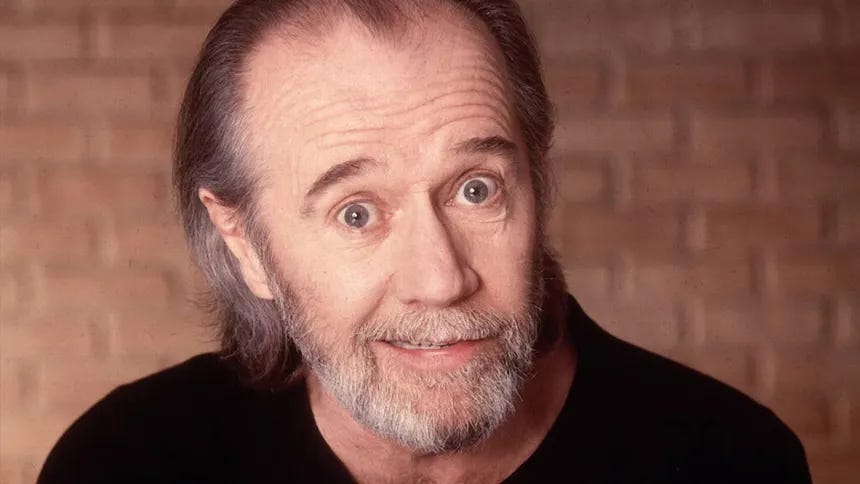
George Denis Patrick Carlin: May 12, 1937 — June 22, 2008.
If a paid subscription isn’t in the cards right now, I completely get it — truly. But if you’ve ever read something here and thought “damn, she needs to keep doing this,” you can throw a few bucks in the tip jar over at Buy Me a Coffee.
No pressure. No guilt. Just me, asking nicely, with my hand out like a very earnest raccoon who writes controversial essays.
☕ buymeacoffee.com/eeviebateman
Thank you for being here. Seriously. You make this worth doing.
George Carlin was authentic and spot on with his comedy and societal commentary . He and Robin Williams were true speaks.
That’s why we still enjoy watching their video clips.
Still resonants today. Both were geniuses.
Great summary of a great American Philosopher. He worked the details, he gave us updates omn our hipocracy, and he made us laugh in. survival mode. His last show aboutt having Owners was so spot on, I knew it at the timem, but I never knew how accurate he was until now. Thanks for theeffort.