

The table was always full.
Every summer, my mom’s side of the family gathered for the reunion — aunts, uncles, cousins spilling into whatever house was hosting that year, catching up on a year’s worth of living. It didn’t matter whose turn it was to host. The moment you stepped through the door, it always smelled the same. Candle wax and something delicious simmering on the stove and a tangle of dishes someone had been cooking since morning. And underneath it all, my grandmother’s perfume — something floral and thick that clung to the curtains for days after everyone had gone home.
Cousins ran the hallways like they owned them. Aunts refilled each other’s wine glasses and leaned close, trading whispered gossip about neighbors nobody at that table would ever meet. Uncles loosened their belts after the second helping and settled deeper into their chairs, talking about hunting season and how this was finally the year their team was going all the way. Someone was always laughing a little too loud. Someone was always telling a story that had been stretched so far from the truth that everyone knew it — and nobody said so.
It was loud and warm and familiar.
And he was always there.
Uncle J was the fun one. He was goofy and silly in a way the other uncles weren’t, the kind of adult who actually got down on your level — asked you questions, played with you, made you feel like you mattered in a room full of grown-ups who were busy being grown-ups. We loved him for that. We competed for his attention without even realizing we were doing it.
He had a thing he liked. He’d settle into his chair after the meal, stretch out, and ask the girls to give him a massage. We’d take turns working on his shoulders and back, little hands doing their best, and whoever dug in the hardest earned a title: Uncle J’s Favorite Niece. We thought it was an honor. We genuinely did. We’d beam with pride, delighted to have won the popularity contest, delighted that he noticed us. Nobody at that table told us any different.
I found out the truth the way you find out a lot of things now — by accident, on the internet, in an ordinary moment that turned into something else entirely.
I was telling my husband about two of my mother’s brothers, how one of them owned his own construction company and had built his dream home before retirement. Both of them had been in construction and I couldn’t remember which one owned his own business, so I typed Uncle J’s name into Google, half distracted, expecting nothing. The search results loaded.
His mugshot looked back at me.
Second degree sexual assault of a child. Registered sex offender. For life.
I sat there for a long moment, not moving. There’s a word for what I felt in that moment. Betrayal. But it wasn’t just the uncle I had loved. It was every adult who had sat at that table and known, and kept passing the rolls anyway.
Through some amateur detective work, I found out the child he abused was his own daughter.
All those reunions. All those summers. All those little girls competing to be Uncle J’s Favorite, so proud, so happy he had chosen them.
He was always there. And our parents hid it from us.
My mother took one look at me and decided she was worth the risk. Though I'm not sure she ever saw it as a risk at all. She had been taught not to. Pedophilia leaves marks on the people around it too, a kind of trained unseeing passed quietly from one generation to the next. My mother didn't know what her brother was, because she had spent a lifetime learning not to look. Or maybe she did know — and silence was the only language she'd ever been given.
What They Put in the Water
Before I knew his name on a registry, I knew other things. I knew that girls were made to be soft. I was taught that softness was next to godliness. I knew that a girl who spoke too loudly, who took up too much space, who asked too many questions, was a problem. It was ingrained in me that I was always second best to the proximity of men. It was all bullshit.
And the Church taught me this with a smile.
God was everywhere.
When things went wrong, it was God’s will. When things went right, it was God showing favor. And when things made no sense at all — when a question sat in your chest too heavy to swallow — God works in mysterious ways, and does not operate within man’s understanding. That was the answer. That was always the answer.
God’s will. Offer it up. Be grateful.
God was the reason you didn’t ask why. God was the ceiling you couldn’t push through, the wall you couldn’t see around, the hand that was always gently, firmly pressing you back down into your place. And somewhere in the architecture of all that faith — tucked inside the prayers and the pews and the careful, quiet obedience — little girls were being trained to stay silent.
And silent little girls are very easy to control.
I don’t think my mother knew she was handing me to the wolves. She had never learned to tell the difference between love and harm. Neither had her mother before her.
It isn’t fair to hold her accountable for what she couldn’t see. I can acknowledge the harm without requiring her to have intended it. The wound doesn’t care about intention — and my healing doesn’t require her to be a villain.
Abuse is generational in my family. My grandfather abused my grandmother. My father abused my mother. My ex-husband abused me. Three generations of women handed the same story and told it was love.
That’s the thing about cycles. They don’t have big red flashy flags screaming in your face. They just keep turning, steady and invisible, generation after generation, until someone finally stands in the middle of it and says, “Absolutely-fuckin-not.”
The Compass That Was Broken Before I Used It
My parents were drowning in their own world — immature in the ways that adults can be when they never quite finished growing up, stuck in patterns formed from their own childhood trauma, tangled in problems of their own making, moving through life with an empathy that had been dulled by lead poisoning and choices they wouldn’t own. There wasn’t much left over for me.
I was a forgotten girl.
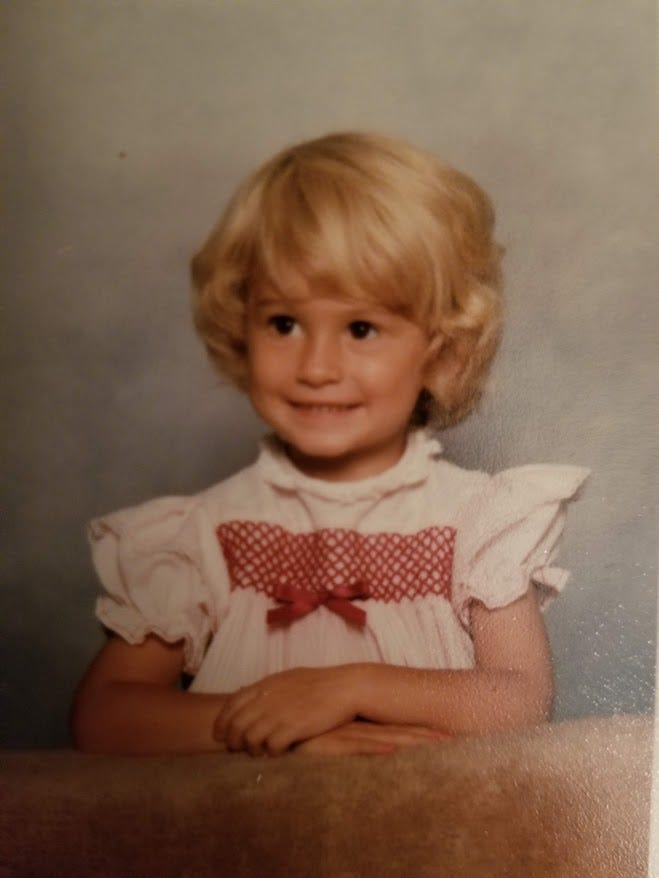
When I started dating, my boyfriends were always older than me. My parents didn't blink. My teachers didn't blink. The neighbors who watched me climb into cars at fourteen, driven by men who should have known better — they didn't blink either. Because this was just how it was, especially for girls of my generation. Older men wanted younger girls. Younger girls were flattered by the attention. That was the story, and we had all agreed to tell it. It felt wrong — it always felt wrong — but it was so woven into the fabric of our world that fighting it seemed like arguing with the weather.
It wasn’t about maturity. It wasn’t about having more in common with someone older. It was about power. For these predatory men, it was about finding a girl whose compass had been quietly broken whose sense of what she deserved had been carefully, methodically lowered and stepping into that gap before she could figure out it was there.
My first husband was four and a half years older than me. My second was almost eleven years older.
I chose them because familiar felt like safe, and I had been taught that love was supposed to hurt a little. That to suffer, was my virtue by God’s design. Older men didn’t confuse me — they confirmed everything I already believed about myself. Second best. That I was meant to be led. That my voice was a courtesy, not a requirement. That the gap between us — in age, in power, in whose needs mattered more — was just the natural order of things. I didn’t know I was repeating a pattern. I thought I was finally being chosen.
They chose me because I was young. Because young meant moldable. Because young meant I didn’t yet know the full measure of what I should expect from a partner. Because young meant that when they pushed, I would bend, and when I bent, they could constantly feed their need to be powerful over someone.
By the time I was well into my 20’s, I stopped bending, like most millennials, because we were one of the first generations to find community and speak up openly about what was happening to us. We exposed the secrets and crushed the gaslighting. We learned to stand up straight and stay rooted in our worth. And the relationships always broke.
Because those relationships were never built for strong, independent women who knew their worth. It was built for the naïve and controllable girls we used to be.
The Pattern Doesn’t Lie
Both of my ex-husbands have remarried.
My first married a woman a decade younger than him. My second married a woman two decades younger than him. I used to find that sad. Now I find it clarifying.
Because it tells me everything I need to know — about those marriages, and about mine. It wasn’t me, specifically. It was never some great love story that just went wrong at the seams. It was a type. A dynamic. A particular kind of woman they knew how to find — young, a little uncertain, carrying just enough trauma to make her question herself, full of hunger and potential and just enough self-doubt to be shapeable. That’s what they were looking for. That’s what they found in me, before I became someone they couldn’t manage anymore.
They look for the vulnerability. They can smell it the way you smell rain before it arrives — something in the air shifts, and they move toward it.
And the thing that keeps me up sometimes isn’t anger. It’s the knowing. Knowing how many women are still sitting at those tables right now, still being told that his attention is a compliment, still watching their compass spin and spin and never understanding why they can never quite find north.
Because nobody told them the compass was broken before they ever picked it up.
How Millennials Broke the Glass
My generation broke something open.
We were the first ones to grow up, look back at our childhoods, and bravely say out loud, in public, this is not okay. We named the creepy uncle. We named the youth pastor. We named the coach and the teacher and the family friend who always wanted to be alone with the kids. We dragged those names into the light and we refused to call it adult business anymore. We became the protection we never had and learned through experience the difference between love and danger.
We called out the hypocrisy hiding inside the churches and the family reunions and the homes that were supposed to be safe. We walked into every dark shadow that had swallowed little girls whole and we turned the lights on and we stayed there until everyone could see.
We had the language our mothers didn’t have. We had the internet, and the therapy, and the women who wrote the books and did the TED talks and told their own stories so that we could recognize ours.
And because we did that work — the hard, ugly, expensive, lonely and often times, dangerous work — our children and grandchildren have the chance to grow up different.
Gen Z doesn’t tolerate what we tolerated. They name it faster. They leave sooner. They have a word for every manipulation tactic, a framework for every boundary violation, a community that will believe them when they speak. They’re not perfect, no generation is, but they are awake in a way we had to fight to become.
That only happened because Millennials decided the silence stopped with us.
What I Want You to Take From This
To the girl who grew up at that table. You know the one. The table where he was always invited. Where love came with conditions you didn’t agree to, and silence was the tax you paid just to make it through dinner. Where adult business was code for you don’t get to know, and you don’t get to say.
I see you.
I see you if your compass was broken before you were old enough to know you’d need it. If you spent years ending up in the same place with different faces and couldn’t figure out why. If you loved men who needed you smaller than you were. If you shrank. If you stayed. If you told yourself it was fine because fine was the only word you’d ever been given.
I see you if you’re still sitting at that table right now.
But you should know, the door is real. The other side of it is real. There is an entire world of women waiting on the other side of the choice you’re afraid to make, women who found their way out of the same dark rooms you’re standing in, women who will grab your hand and hold it and not let go. Women who lost it all, to gain everything.
The creepy uncle doesn’t get an invite anymore. Not to my table. Not to yours.
Flip that fucker over and build a new one.
THANK YOU for this. I'm not a millenial. I'm a boomer. And I can never find the words to express how I feel and it infuriates and saddens me. You've written it for me. Thank you for this.
I too, am a Boomer.
It’s been a long hard battle, speaking up, 2 1/2 years through the judicial system, the offender declared dangerous and incarcerated indefinitely and died of bone cancer 10 years after he was imprisoned. That was 31 years ago.
There are still far too many victims who live in the silence and have not found The Courage To Heal.
Look to the work of Gabor Mate.