

Raise your hand if your favorite movie as an older Millennial or GenX is Dirty Dancing… AND you’re a childhood sexual assault survivor 😳
You know it’s not about endorsing age gaps or saying “this is fine.” You’re not naive. You’ve spent years untangling what happened to you. You know the difference between a movie and real life better than most people ever will.
But you also know that this film does something to you. And maybe you’ve wondered why.
Well, I have a theory…
CSA doesn’t just leave memories. It rewires you. It fuses secrecy with intimacy. It tangles desire with shame. It teaches your body that male attention equals danger, obligation, performance. Long after the abuse ends, those patterns stay—not as thoughts you can argue yourself out of, but as things you feel before you even know you’re feeling them.
If you’re drawn to a film like Dirty Dancing, it’s usually not about the romance. It’s about something deeper. Something the nervous system recognizes.
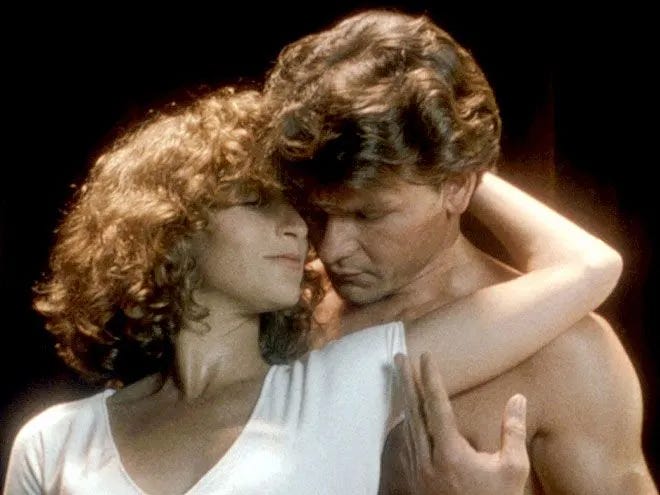
The movie contains familiar ingredients: secrecy, an authority figure’s disapproval, a younger woman and an older man. For a survivor, those elements aren’t neutral. They echo. What’s different and what matters is that the story doesn’t end the way your story did.
In abuse, power is taken. In grooming, choice is obliterated. In what happened to you, your body wasn’t yours.
In the film, those dynamics flip. Baby moves toward what she wants. She insists. She participates. She isn’t silenced into compliance—she steps into visibility. The secrecy isn’t a trap. It becomes a space where she builds skill, confidence, voice. And the most powerful moment isn’t sexual at all. It’s public. It’s her walking forward, in front of everyone, without apology.
For a survivor, that shift lands differently than it does for someone else watching. It presents a version of intimacy where you don’t have to disappear.
That doesn’t mean the age gap is irrelevant. It doesn’t mean those dynamics are harmless in real life. You know they often aren’t. You know that more intimately than anyone.
But trauma will always pull you back toward narratives that resemble what hurt you—not to retraumatize yourself, but because your psyche is looking for a different ending.
This is called repetition with revision.
Your nervous system recognizes the setup—secrecy, male authority, risk—and leans in, searching. Watching to see if this time, it goes differently. Watching a young woman choose instead of being coerced. Watching a father get confronted instead of obeyed. Watching desire exist without shame attached to it.
That’s not fantasy, it’s integration work.
Survivors often gravitate toward art that mirrors the original wound because somewhere inside, we’re trying to gain mastery over what once had mastery over us. We return to what hurt us—not to relive it, but to see if we can rewrite it. Cinema becomes a rehearsal space for autonomy we were never allowed to have.
Loving Dirty Dancing might mean you’re holding an unconscious longing to see your younger self protected by her own agency. It might reflect a hunger to untangle sexuality from secrecy. It might be about witnessing a patriarchal structure get challenged.
It’s not about approving of older men pursuing younger women. It’s about recognizing that stories involving power and desire will always feel charged when your own power was once stripped away.
When you look honestly at the stories you love, you’ll often find trauma fingerprints in the plots. That’s not shameful. It’s clarifying.
Your tastes aren’t random. They’re patterned. They point toward unresolved pain, yes—but also toward unfinished reclamation. Toward the exact medicine you needed but never received.
Seeing that connection isn’t self-condemnation. It’s understanding that even your entertainment choices are maps. They lead back to the places where your autonomy was interrupted—and forward, toward the possibility of taking it back.
I used to feel broken for loving this film.
But now, I know I’m just human and doing the work of healing, one story at a time.