

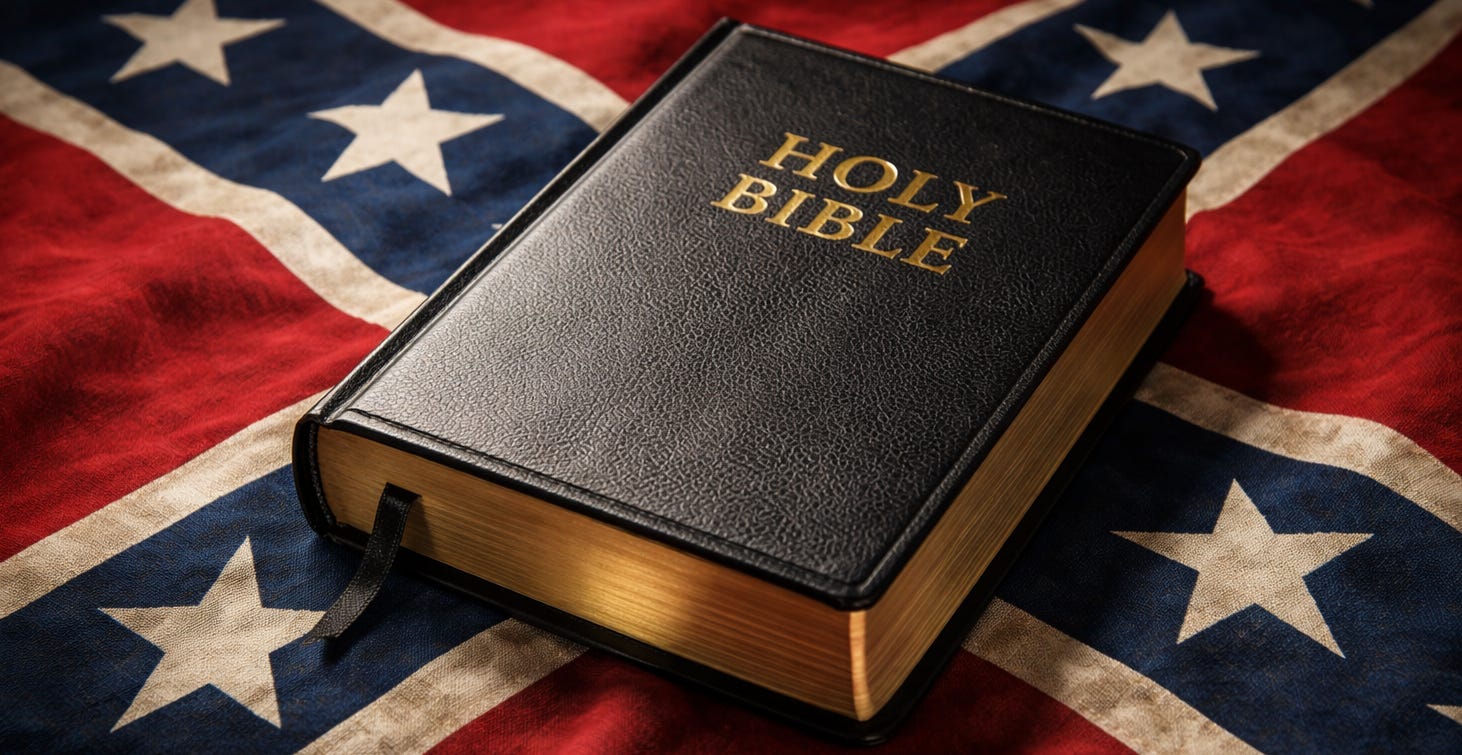
I live in Texas, in the heart of Bible Belt USA, surrounded by crosses and pictures of white Jesus next to confederate flags next to signs about how God hates gay people. There isn’t a day that goes by when I don’t shake my head wondering how the hell I ended up here — especially since the explosion of loudmouth Christian Nationalists who decided to make themselves known in 2024. Before then, they stayed relatively quiet, at least in my experience. But, then Fascism's Participation Trophy was elected and it gave them the green light to show themselves loud and proud. And boy did they ever.
I’m originally from the U.P. of Michigan, or southern occupied Canada, as some refer to it. Raised by racist, homophobic, patriarchal Catholics. When the time came, I got the hell out. I ended up in Texas mostly because of job opportunities after going no contact with my family, but putting maximum distance between myself and where I came from was the main goal. I deconstructed my beliefs, found that Texas, particularly Austin and Dallas, was doing the same, and landed in a community of fellow deconstructors who made it feel like home. Over the past ten years, I’ve learned a lot from the cosplay Christians I run into. Most are absolutely certain God said certain stuff and they claim the Bible proves it.
He didn’t say it. And the Bible said nothing of the sort. Or it was added later. Or someone made it up entirely.
The word “homosexual” wasn’t in the Bible until 1946.
Yep. The word didn’t even exist in English until the late 19th century and didn’t appear in any Bible translation until 1946, when the Revised Standard Version used it to replace two Greek words — arsenokoitai and malakoi — whose meanings scholars have debated ever since. Paul was condemning exploitation and abuse, not same-sex orientation, which is a modern psychological concept that simply didn’t exist as a framework in the first century. He was condemning the sexual exploitation of the powerless — something everyone agrees is wrong — and in 1946 that got collapsed into a blanket condemnation of gay identity that Paul never wrote and likely never imagined.
Same-sex attraction has existed since the beginning of time. What didn’t exist yet was the idea of it as an identity — something you are rather than something you do. Ancient writers weren’t describing gay relationships. They were describing power and dominance. Translating that as “homosexual” in 1946 and then treating it as eternal divine law is, at minimum, a significant interpretive leap.
The Bible says abortion is murder.
It doesn’t. Numbers 5 describes a priestly ritual that induces miscarriage. The one passage that directly addresses fetal harm — Exodus 21 — treats it as a property crime against the father, not murder. There is no Biblical passage that grants personhood to a fetus. The theology that does so is largely a post-1970s political construction, built to serve a specific agenda, and retrofitted onto scripture after the fact.
Numbers 5:11-31. It is canonical scripture, in every version of the Bible — King James, NIV, RSV, all of them. It was never removed, never disputed as an addition, and has been sitting there the whole time.
Which is part of what makes the entire abortion argument so remarkable. The people most loudly insisting the Bible condemns abortion have a God-ordained miscarriage ritual in their own book and either don’t know it’s there or are hoping you don’t.
The lie that Christmas is ancient and Christian.
December 25 has no Biblical basis. Early Christians didn’t celebrate birthdays — the practice was considered pagan. The date was almost certainly chosen to absorb existing Roman festivals, particularly Saturnalia and Sol Invictus. The traditions most associated with Christmas, decorated trees, gift exchanges, feasting, have pre-Christian pagan origins. Christians didn’t invent Christmas. They rebranded it.
Jesus wasn’t even born in December. The shepherds-watching-flocks detail in Luke is the best internal clue, and it points to spring, so most likely he was born in March or April. By late fall and winter, flocks were brought in at night because of cold temperatures. The image of shepherds in the fields at night in December doesn't hold up climatically or agriculturally for that region. It's well established that the church picked December 25 for political and cultural reasons, not historical ones.
The Bible has been faithfully preserved.
Full stop. This is absolute horseshit. The King James Bible was translated from manuscripts that were themselves copies of copies of copies, with thousands of documented textual variants between them. The ending of Mark (16:9–20), the story of the woman caught in adultery (John 8), and the explicit Trinity verse in 1 John 5:7 are all widely recognized by scholars as later additions not found in the earliest known manuscripts. They were inserted. The Bible that millions treat as the unaltered word of God has been edited, added to, and revised by human hands across centuries.
And that's before you get to what was left out entirely. The Book of Enoch, one of the oldest Jewish religious texts in existence, directly quoted as scripture inside the Book of Jude, didn't make the cut. Neither did the Gospel of Mary, the Gospel of Thomas, the Gospel of Judas, or the letter Paul himself references in Colossians that apparently got lost. Men in rooms, across multiple councils spanning centuries, decided what was and wasn't the word of God. The Ethiopian Orthodox Church never agreed with those decisions and still includes Enoch as canon today.
That's not divine preservation. That's a committee. And committees have agendas.
Satan rules Hell as God’s adversary.
When I first began deconstructing religion and healing the trauma it inflicted, someone asked me a simple question, “Have you ever asked yourself why you believe?”
I sat with it for a moment because I had to really think about the why. Eventually, I came to my answer, “Because I don’t want to burn in Hell.”
That was the story ingrained in me from birth. Believe in God or burn, tortured in Hell by Satan for all of eternity. It was the foundational threat underneath everything. The floor of my entire belief system was fear.
Here’s the problem with that. The Satan I was afraid of, the one with the pitchfork and the torture kingdom, gleefully presiding over an eternity of suffering, isn’t even in the Bible. That character was built by poets and finished off by Hollywood. What’s actually in the text is considerably less cinematic and significantly more complicated.
In the Old Testament, “satan” isn’t even a proper name. It’s a Hebrew word — ha-satan — meaning “the accuser” or “the adversary.” It’s a job title, not an identity. The figure who holds that title appears in the divine council, works within God’s system, and functions essentially as a prosecuting attorney. His job is to test humans on God’s behalf. He isn’t evil. He’s adversarial by design, the way a prosecutor is adversarial by design.
The clearest picture of this is Job 1:6-12, where the sons of God, including the satan, present themselves before God. God and the satan have a conversation. God gives the satan permission to test Job. This is not a rebel operating outside God’s authority. This is an employee doing his job.
In Zechariah 3:1-2, the satan stands at God’s right hand as an accuser in a legal proceeding. Again, functioning within the divine court, not opposing it from the outside.
The passage most cited as describing Satan’s fall from heaven is Isaiah 14:12 — “How you have fallen from heaven, morning star, son of the dawn.” Scholars broadly agree this is a taunt directed at the King of Babylon, not a description of a supernatural being. The Latin translation rendered “morning star” as Lucifer, which became a proper name, which became an entire mythology. Lucifer as Satan’s name comes from a mistranslation of a political poem about a human king.
In the New Testament, Satan becomes more developed as a figure — but still not the ruler of Hell. In Luke 10:18, Jesus says “I saw Satan fall like lightning from heaven” — metaphorical, not cosmological. In Matthew 4, Satan tempts Jesus in the wilderness, functioning as a tester, consistent with his Old Testament role.
In Revelation 20:10 — the text most directly about Satan’s ultimate fate — he is thrown into the lake of fire and sulfur, where he is tormented day and night. He isn’t running Hell. He’s being punished in it. He is a prisoner, not a warden.
The horns, the red skin, the pitchfork, and the tail were borrowed from medieval depictions of the pagan god Pan and grafted onto the Biblical figure across the Medieval period. Dante’s Inferno in 1320 gave him a kingdom. Milton’s Paradise Lost in 1667 gave him personality and ambition — including the famous line “better to reign in Hell than serve in Heaven,” which is Milton, not scripture. Between those two literary works, a character was constructed that has almost nothing to do with what’s in the actual Bible.
The Satan most Christians fear is a fictional composite assembled over centuries from mistranslations, medieval art, and two of the greatest poems in the Western literary canon. The Biblical figure is a prosecutorial functionary operating inside God’s own system.
They were terrified of a character from literature. I know because I was one of them.
Jesus was not white. And probably not celibate.
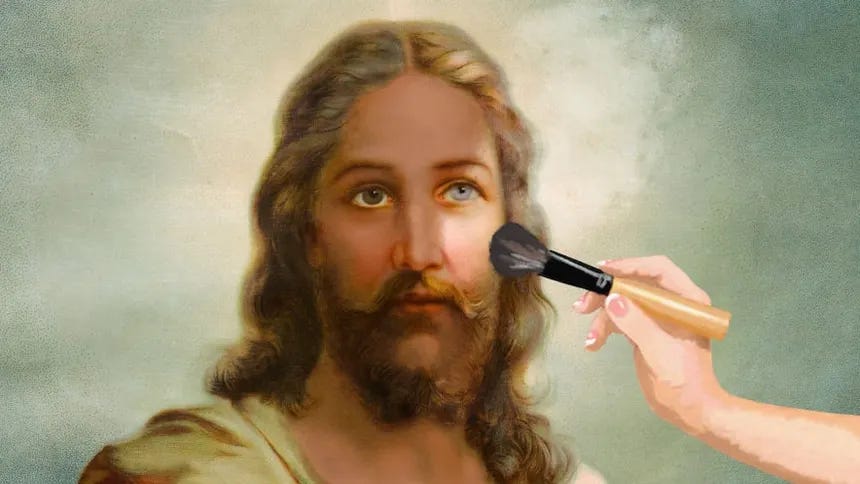
Jesus was a first-century Jewish man from Galilee. Forensic anthropologists and historians broadly agree he would have had dark olive to brown skin, dark eyes, and short curly hair. Closer in appearance to a modern Palestinian or Mizrahi Jewish man than anything hanging in a Western church. The hippie white guy version solidified through Byzantine and Renaissance European art, where painters rendered him in their own cultural image because that’s what painters do.
There is zero historical or textual basis for white Jesus. There’s even unverified lore that the specific portrait most churches use is modeled on Michelangelo’s gay lover — which, if it ever gets proven, is going to make a lot of Sundays very awkward.
The celibate, wifeless Jesus is a theological position, not a historical fact. An unmarried Jewish rabbi in first-century Palestine would have been a genuine anomaly — marriage wasn’t optional, it was expected. Mary Magdalene was present at the crucifixion, the burial, and was the first witness to the resurrection across multiple gospel accounts. That’s not a peripheral role. The Gospel of Philip, excluded from the canonical Bible, describes her as Jesus’s koinonos, a Greek word meaning companion or consort, and says he kissed her often. The people who decided which texts made it into the Bible had theological and political reasons to prefer a celibate Jesus.
The Rapture isn’t in the Bible.
This is the one that should rattle the most cages, because it’s treated as bedrock by enormous swaths of American evangelical Christianity. Left Behind, end times prophecy, all of it. The Rapture as commonly understood that believers suddenly vanishing before a period of tribulation. It was invented in the 1830s by a British preacher named John Nelson Darby. It spread to America through the Scofield Reference Bible in 1909, which solidified Darby’s interpretive framework directly into the footnotes alongside scripture, causing generations of readers to absorb it as if it were the text itself.
The most cited passage is 1 Thessalonians 4:17 — “caught up together in the clouds.” Scholars noted that in context, Paul is describing a greeting procession, the kind performed when a dignitary arrived at a city, where people went out to meet them and then returned together. Not a disappearance.
The word “rapture” appears nowhere in the Bible. The seven-year tribulation, the sequential end times, the secret vanishing — none of it predates Darby. It is a 19th century theological invention that would have been completely unrecognizable to any Christian who came before him. And yet millions of Americans treat it as ancient, literal, and non-negotiable. It is arguably the most successful retcon in modern religious history.
Someone just made it up. And it stuck.
Religions are in place to up hold patriarchy.
Patriarchy is about control, dominance, and ownership of others, especially females.
Patriarchy requires lies, propaganda, abuse, and violence to maintain.
Patriarchy harms all people.
Patriarchy is responsible for everything from rape to war.
The bible is a book of lies written, and rewritten, by damaged males.
When someone uses fear to control you, know they are an abuser.
Divine Spirit is energy, does not have a body, and certainly is not male.
Accurate names and pronouns would be gender neutral like Divine Spirit, The Divine, The Light, Source, The One, Holy Spirit, Great Spirit, and the pronouns of they/them.
People can develop their own intuition, and connect directly with Divine Spirit.
Religions actively condemn that, because it would take their control away.
Fellow Upstate girl in Texas (NY rather than MI, but the Canada reference is spot on). I have the more my faith is deconstructed, the more I love story and feel closer to God. It becomes the universal truth the binds so many religions together. Love for neighbor, belief in something greater. None of what is being peddled as Christian is remotely close to “the Way” the original message of Jesus which was actually quite political and anti oppression.