

Fuck.
I remember the first time I said it and meant it.
It wasn’t because of the accidental stub-your-toe, or the whispered, guilty, immediately-repented version that I’d been hoarding in the back of my throat since adolescence like a secret love child. I’m talking about the first time I said fuck out loud, with my whole chest, and felt nothing afterward, except the pure satisfaction of a word that finally fit the moment it was describing. Pure liberation and ownership!
I was once a woman who had spent the better part of her life being carefully, methodically, and theologically managed. And that word — that single, stubborn, ungovernable syllable, was the first thing I’d said in years that nobody had pre-approved.
It tasted like freedom. I’ve been saying it ever since and offending pearl-clutchers everywhere I go. Fuck it.
The word is older than your umbrage, and far more interesting than the look on some faces when spoken out loud. That exquisitely wounded dignity of someone who has apparently spent their entire sanctified life thinking only approved thoughts and looks like they just witnessed you kicking a puppy at a christening.
Fuck has been recorded in English since the 15th century — which means, it predates the United States, the Mayflower, and most of the institutions people invoke when they’re trying to tell you how to speak. It was here before your great-great-great-great-grandmother’s great-grandmother drew her first breath, and she probably said it too, quietly, where the men of the house couldn’t hear her.
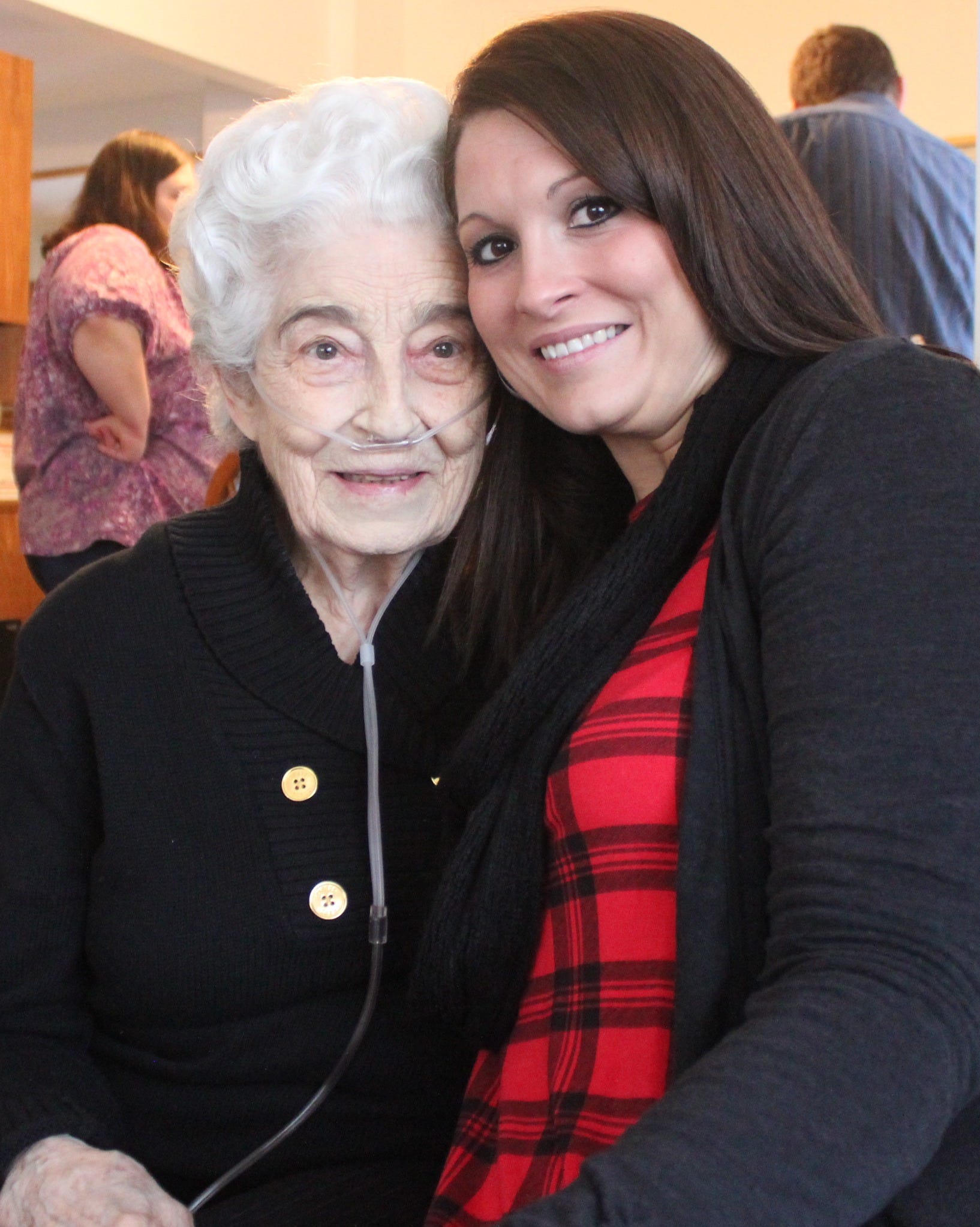
I accidentally heard my grandma say it one time when she didn’t think anyone was around. And it was glorious! I didn’t want to embarrass her though, so to this day, she still doesn’t know I heard her. She just turned 101 years old. Maybe I should tell her my secret… or maybe this is between her and her god and I should just continue minding my fuckin business.
Here’s a picture of me and my favorite foul-mouthed matriarch:
The earliest currently known reference in the historical record comes from a 1310 Chester County Court case featuring a man named Roger Fuckebythenavele. Let’s just pause for a moment and properly appreciate that the oldest documented evidence of this word is a man whose entire legal identity was constructed around it. Roger didn’t just say fuck. Roger made it his whole personality, and the court had to write it down, which means Roger won.
You can read more about it here: Roger Fuckebythenavele
In 1528, an anonymous monk scrawled into the margins of a Cicero manuscript: “O d fuckin’ Abbot.” A monk. Annotating moral philosophy. With the f-word. I don’t know what the Abbot did, but I think about that monk constantly — a man inside an institution built on obedience and silence, finding the one square inch of parchment where he could say exactly what he thought. I understand that impulse on a molecular level. Living here in Texas, I have my own Abbott problem that I wish would fuck right the fuck off.
The word most likely came from Low German, related to words meaning “to strike” or “to move back and forth.” Not so much from a royal decree or an acronym. The word did not originate as an acronym. Such etymologies are almost always false. “For Unlawful Carnal Knowledge” is a fabrication people invented because they needed fuck to have a shameful origin. The actual origin was used by ordinary people, talking the way ordinary people talk, out of earshot of whoever held authority over them, and it wasn’t scandalous enough to justify all the energy spent trying to suppress it.
The people in power, naturally, were apoplectic. Fuck was outlawed in print in England by the Obscene Publications Act of 1857 and in the United States by the Comstock Act of 1873. It was banned from the English dictionary from 1795 to 1965. One hundred and seventy years of pretending the word didn’t exist while everyone absolutely kept saying it.
The same era, incidentally, in which women couldn’t vote, couldn’t own property, and couldn’t speak in public forums without someone deciding their deportment was the real issue. I’m sure that’s a coincidence, right? I’m sure those things are completely un-fucking-related. I’m sure the same people legislating language were not also legislating women’s bodies. Right? …Right?

I love the word fuck for so many reasons. One of reasons being how versatile it is.
Fuck functions as a transitive verb, an intransitive verb, an adjective, an adverb, a noun, and an interjection. It is the most grammatically promiscuous word in the English language, and I mean that as the highest possible compliment. It does six jobs simultaneously and never once asks to be thanked for it. You know… like a woman.
Women have been around forever, they do everything asked of them and then some, get called inappropriate in rooms where they make people uncomfortable by encouraging feelings, and every few generations some fuckwit man in a position of authority tries to have us banned… but, we’re still here anyway.
The word fuck can also be embedded inside another word for emphasis, like, abso-fucking-lutely, un-fucking-believable, in-fucking-credible — a construction linguists call expletive infixation, which is a real academic term that real scholars invented because fuck is so syntactically audacious it required new vocabulary just to describe what it was doing. The word expanded its own field of study. Fuck yeah, respect the hustle.
People who tell you to find a more sophisticated alternative have never actually attempted the substitution. Replace fuck in any sentence where you genuinely meant it and see what survives. “Oh, fiddlesticks” is not the same sentence. “Rats” is not doing the same work. “Forget it” is epistolary cowardice trying desperately to look like restraint. Fuck is for people who decided to be precise about what they felt, which is — and I cannot stress this enough — a virtue, not a deficiency.
I grew up inside religious patriarchy. “Religious upbringing” can conjure something quaint. There were lots of Spaghetti Sunday dinners, hymns, a grandmother with strong opinions about image and what a proper lady looks and sounds like. It’s a system with actual theology behind it. Scripture deployed as truth and framework — building the walls of what a woman was permitted to be, permitted to want, permitted to say. Submission was not suggested. It was doctrinal. Modesty was not a preference. It was a covenant. Your voice, your body, your anger, your ambition — all of it existed in relationship to male authority first, and to you second, and that ordering was presented as divine design rather than what it actually was. It was an extraordinarily efficient system of fuckin’ control.
You were taught to speak softly. To end your sentences with a slight upward inflection, as though everything you said was a question subject to approval. To preface your opinions with apologies. To convert your rage into something that wouldn’t alarm anyone, preferably into a prayer, ideally into silence. Research on women’s speech found that women are more likely to use verbal genuflection, hyper-correct grammar, and overly polite constructions. And more likely to “speak in italics,” stressing words because the speaker fears she is not being listened to.
And it wasn’t just speech. It was the whole apparatus. The sartorial modesty that made your body a liability. The emotional management that made your feelings someone else’s burden to approve. The epistemic submission that made your thoughts provisional until a man confirmed them. All of it running simultaneously, all of it presented as virtue, all of it designed to make a woman legible, or, lets not beat around the fuckin’ bush — manageable — to the people whose authority depended on her staying small.
Women have only been able to swear in public without severe social or legal consequence for the past few decades. In the ecosystem I grew up in, that timeline was considerably more recent. Profanity from a woman wasn’t just impolite. It was transgressive in a way that carried genuine consequences, socially, spiritually and within your own family. The word fuck wasn’t merely vulgar, it was proof of a woman who had gotten above herself. But I like it up here, so fuck it.
Tone policing is a logical fallacy. It focuses on how something is expressed rather than the truth of what’s being said, in order to dismiss the argument entirely. In the Catholic church I grew up in, tone policing didn’t even need to be invoked consciously. It was pre-installed. Women internalized it young and maintained it themselves, which is the most elegant feature of that particular system of control. It eventually stops needing external enforcement because you learn to do it from the inside.
Tone policing is a silencing tactic. It’s part of a set of tools used to prevent people from sharing their experiences. I spent the first portion of my life being policed so thoroughly that I became fluent in self-censorship. I didn’t just monitor my language. I monitored my affect, my volume, my facial expressions, my level of certainty when I spoke. I was a one-woman propriety committee, and the committee met constantly, and it was exhausting, and it never produced anything except a version of me that was easier to dismiss.
Sojourner Truth didn’t get asked to moderate her delivery. She got asked whether she was even a woman. Ida B. Wells didn’t get asked to soften her journalism. Instead, she got run out of Memphis at gunpoint. The mechanism for neutralizing women who refuse to be managed has always been to redirect the conversation from what they’re saying to how they’re saying it.
Telling a woman to watch her language is a more socially acceptable deployment of the same tactic. It is a way of saying, your freedom is creating turbulence in my comfort, and your turbulence is more objectionable than my comfort requires adjustment. Anyone who tone polices me these days, get’s a resplendent “GET FUCKED,” to the face.
I am a white woman who was handed a very specific patriarchy plan at birth. It had scripture citations in the margins and submission in the subtext and about a thousand and one unspoken rules for how to exist in a room without taking up too much of it. For a long time I followed that script with the dedication of someone who had been convinced that deviation was not just impolite but genuinely dangerous.
And then I stopped. Childhood rape, abusive men, religious trauma and patriarchal white women were the straws that didn’t just break the camel’s back for me, but rather, shattered my very existence of who I was being forced to be. I told the entire system and everyone in it to fuck off.
First it was incrementally, then suddenly, then irreversibly.
I’ve been no contact with every single person in my old life for ten years now and in that time, discovered exactly who I am and who I was never supposed to be. I stopped managing myself for the comfort of a system that was never actually concerned with mine. I stopped translating my thoughts into something pre-approved before they were allowed to leave my mouth. I stopped performing a version of femininity that was, upon close inspection, just a very elaborate apology for existing.
And somewhere in that process, I started saying fuck — with my whole goddamn chest.
Fuck has been with the English language for over seven hundred years. It has survived the Obscene Publications Act, the Comstock Act, a hundred and seventy years of dictionary exile, and every generation of scandalized custodians who were certain this time, finally, the word would bring down civilization. Civilization remains. The word remains. Language, it turns out, is considerably more tenacious than the squeamishness of people who benefit from other people’s silence.
Fuck is a cultural indicator, a tool that has been used to marginalize its users, and simultaneously a form of resistance. It is a word that refuses to be respectable, refuses to be domesticated, refuses to perform palatability for the people who would prefer it didn’t exist. I find that quality genuinely fucking admirable in a word.
I say fuck because it’s honest. Because it is gloriously, defiantly insubordinate in the same way I spent years being told not to be. Because the girl who’s life was supposed to be predestined for her, that didn’t include this word, grew into a woman who uses it with the easy fluency of someone who has permanently revoked the committee’s operating license.
Some days it’s the only word that fully inhabits the moment I’m in. Some days it’s the first word that’s entirely mine.
I made it out. I’m free. And I am loquacious, well-read, intellectually rigorous, and abso-fucking-lutely foul-mouthed and fluent in Fuckanese, and those things are not in conflict — they never were. The system that told me they were had a vested interest in my believing it.
So to that system, and everyone still running it, I have two words for you.
GET FUCKED.
If a paid subscription isn’t in the cards right now, I completely get it — truly. But if you’ve ever read something here and thought “damn, she needs to keep doing this,” you can throw a few bucks in the tip jar over at Buy Me a Coffee.
No pressure. No guilt. Just me, asking nicely, with my hand out like a very earnest raccoon who writes controversial essays.
☕ buymeacoffee.com/eeviebateman
Thank you for being here. Seriously. You make this worth doing.
This is pure fucking gold. 💛
Wow Fuck this was a great article. Thank you Evie. Fucking brilliant. I enjoyed your picture. Thank you for sharing. Yeah lol 😆 your grandmother looks like she never used that word. But the thought of her saying it quietly is cracking me up.